



Package Activities
My role
Platforms
Web (Desktop & Mobile)
Team
Package Holidays
Role
Research & Product Design
Timeline
June – August 2023
Goals & Metrics

Give customers the information they need to evaluate activities confidently in order to conclude their purchase decision.
Increase average order value for packages with additional activities
Discovery
Activities was one of my first projects at Secret Escapes, and being a really fun topic, I was keen to learn as much as I could!
1
Requirements gathering
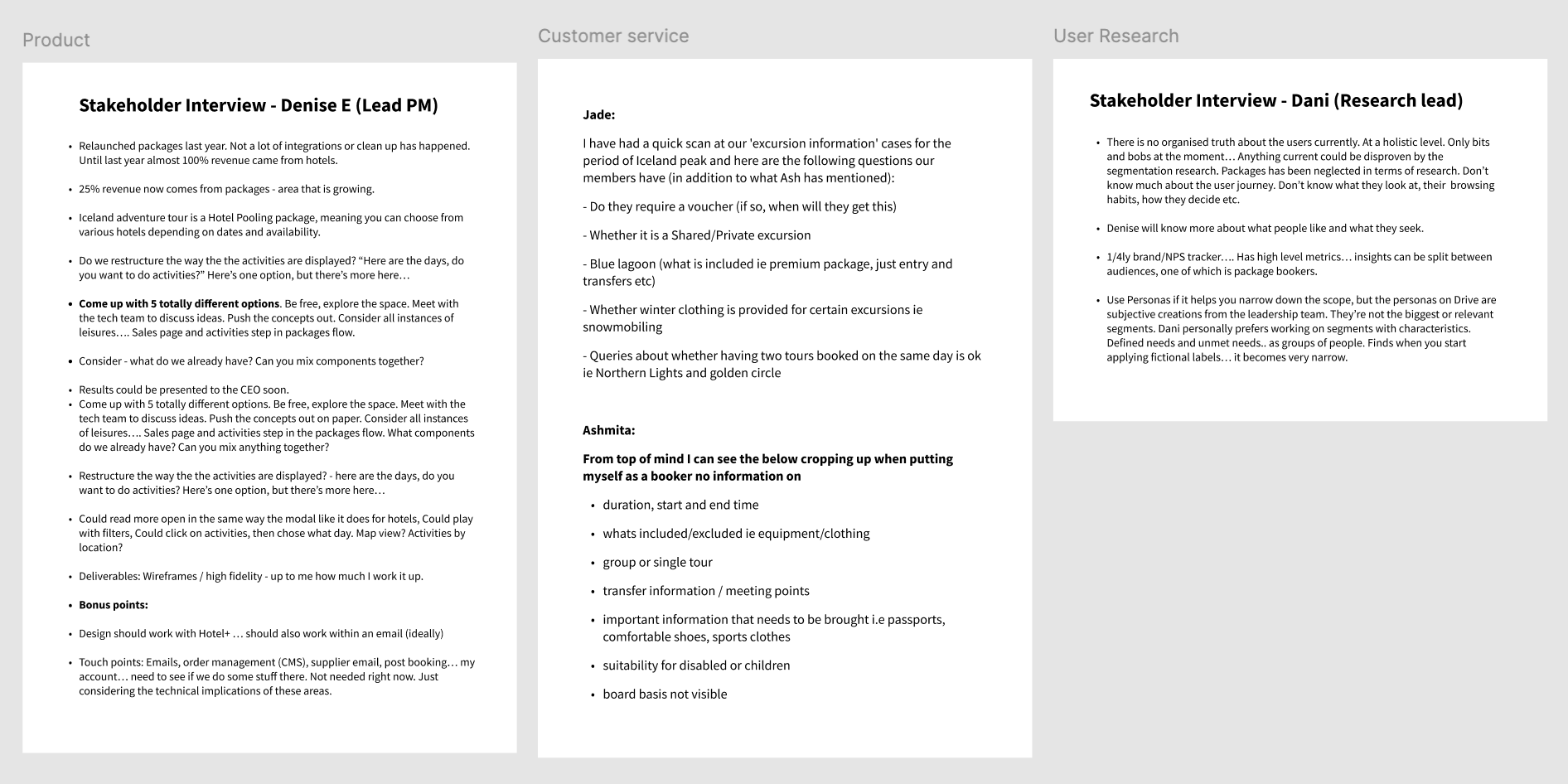
- I spoke with the PM to understand the commercial context of the project, what was in scope and what we were hoping to achieve.
- I spoke with the customer service team regarding the enquries and complaints they get from members on the topic. They gave me a clear picture of the information gaps that were frustrating members and creating additional work for the business.
2
Heuristics & Guidelines
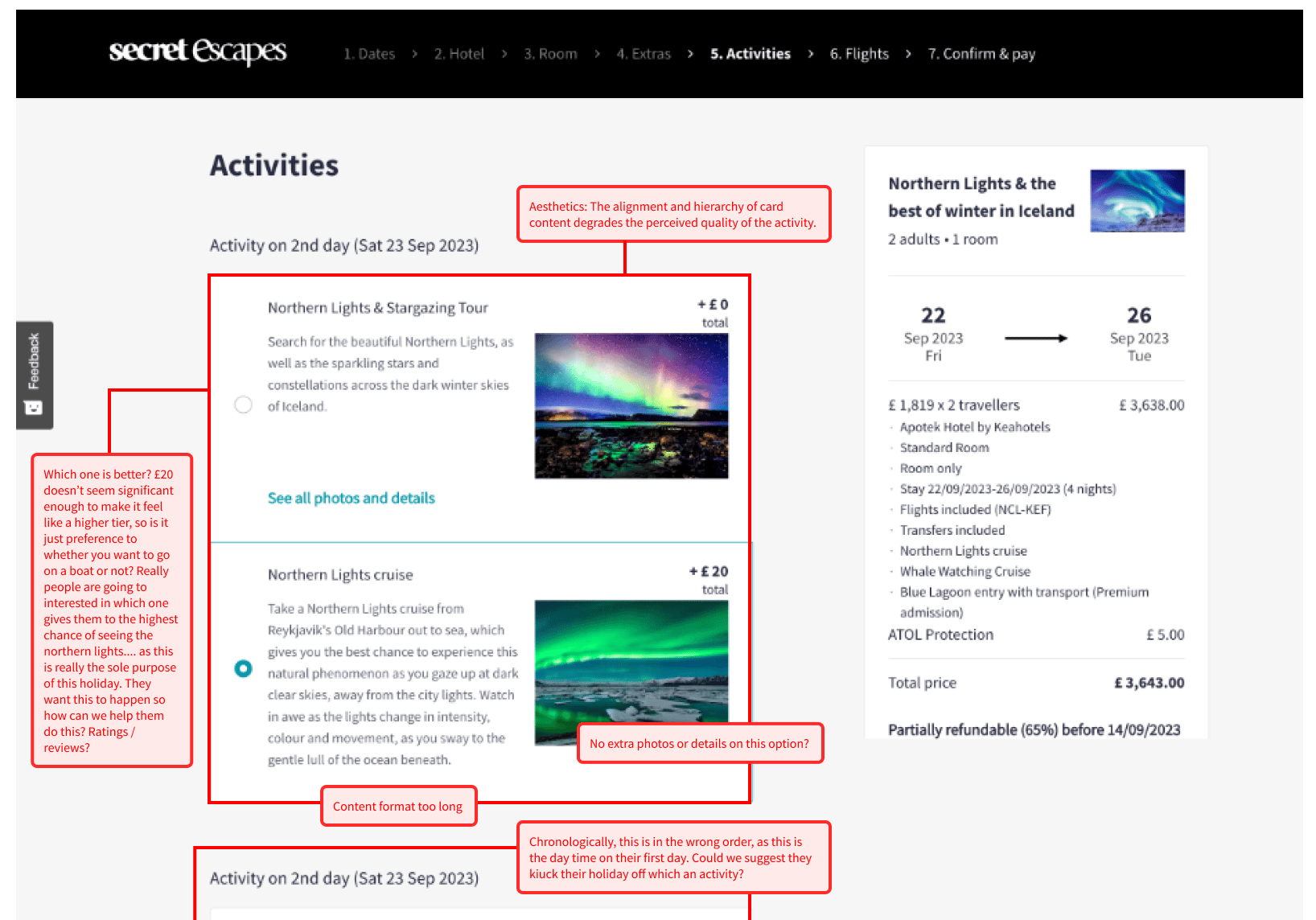
- I conducted a heuristic mark-up of the current experience, noting my observations and gut reactions to the experience.
- Baymard Institute provided useful insight into user’s expecatations, which corrleated with requirements that had come from the Customer Service team.
- I also referenced Think With Google's research on the psychology and behaviour behind e-commerce purchase decisions.
3
Secondary & Competitor research
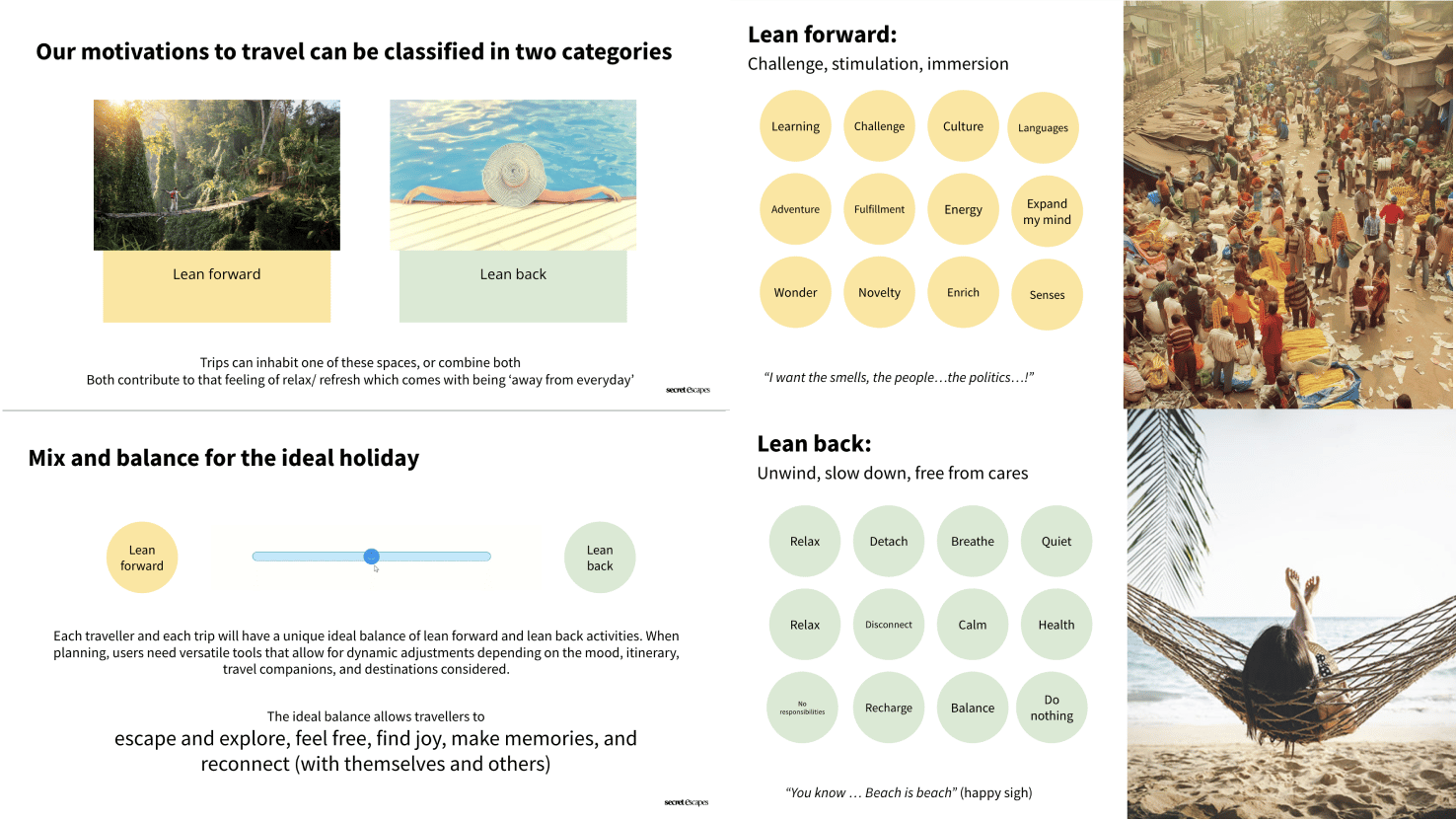
- The Research Lead shared insight reports with me and recommended viewing recently moderated user sessions on the topic.
- I learnt that package bookers have two key drivers: lean forward (challenge, stimulation, learning) and lean back (rest, calm, escape from routine). The best itineraries balance them deliberately.
- Competitor products such as GetYourGuide, Viator, and Holibob provided an interestng benchmarking opportunity. insight into design patterns points for understanding user expectations and needs.
2
Moderated interviews
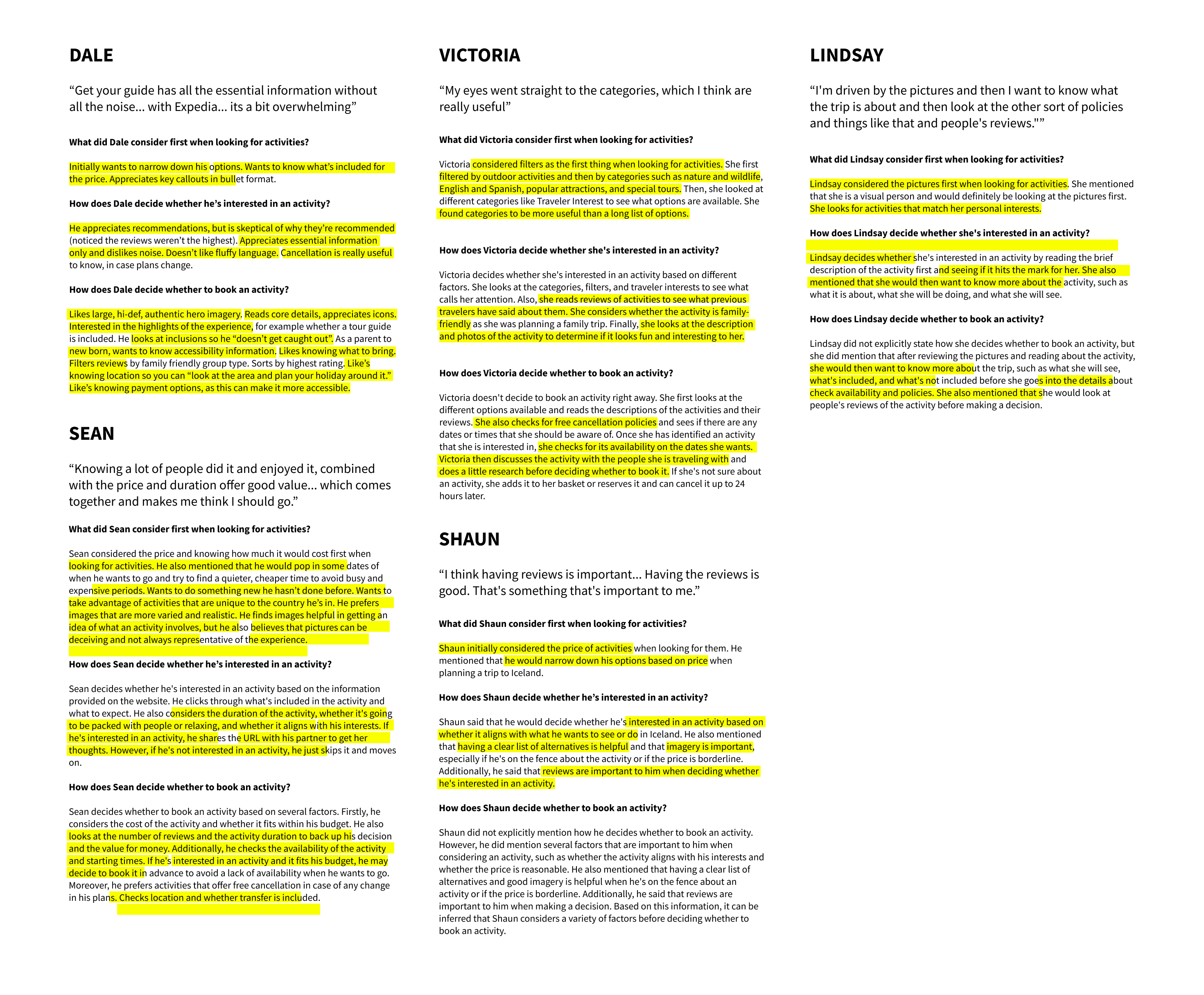
- I interviewed 5 target users to understand how they think about trip activities and what they need to make a purchase or upgrade.
- They walked me through their process of discovering and deciding on activities for a mock trip using 3 competitor products: They navigated activity selection on TripAdvisor, GetYourGuide and Expedia.
- Three consistent themes emerged:
- Personal interest drove attachment more than any other factor. When an activity matched what the participant wanted to do, they were willing to spend more.
- Duration was a proxy for value. Without it, customers couldn't assess whether an activity was worth the price or fit their plans.
- People want proof. Authentic, high-quality activity photography built confidence, and reviews provided the credibility needed to convert.
The problem space
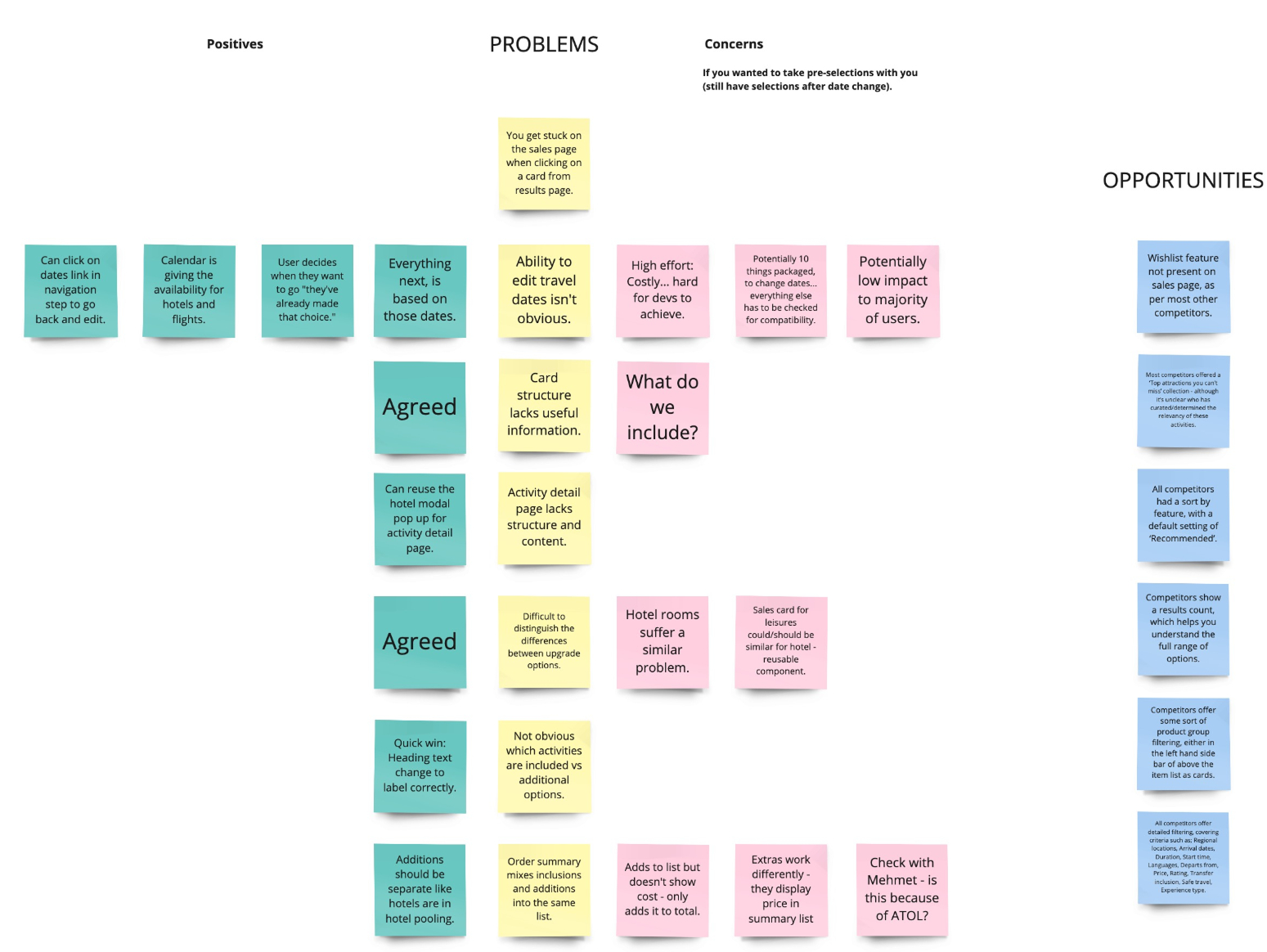
Prioritisation
There were a lot of opportunities to improve the user experience for activity selection. current experience fell well short of what users and the industry likely considered a an activity booking experience.
I walked my product partner through the problem space, discussing each problem and note taking about the positive and negative aspects of each issue.
Out of scope
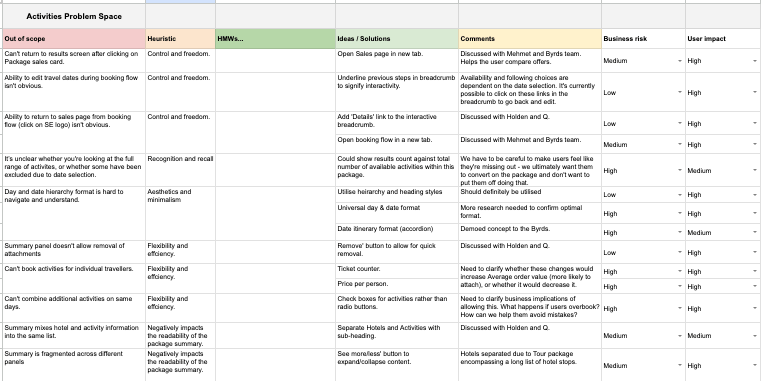
Many of the issues discovered were outside the scope of this project. Instead of losing them, I created a Google Sheet that documented all the issues I’d discovered and shared it with the PM. A useful opportunity space for another day.
Agreed scope
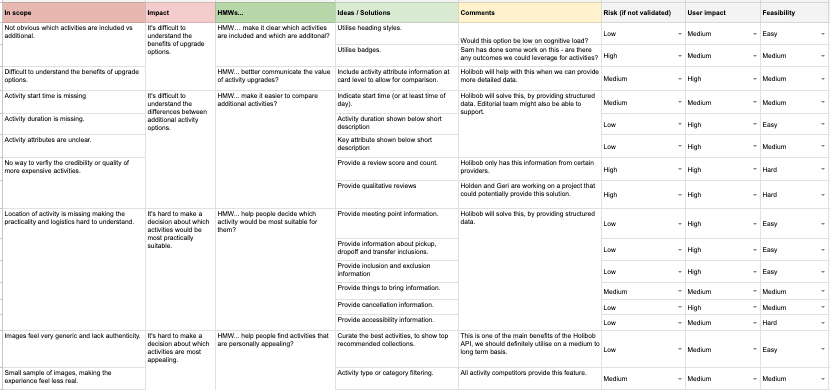
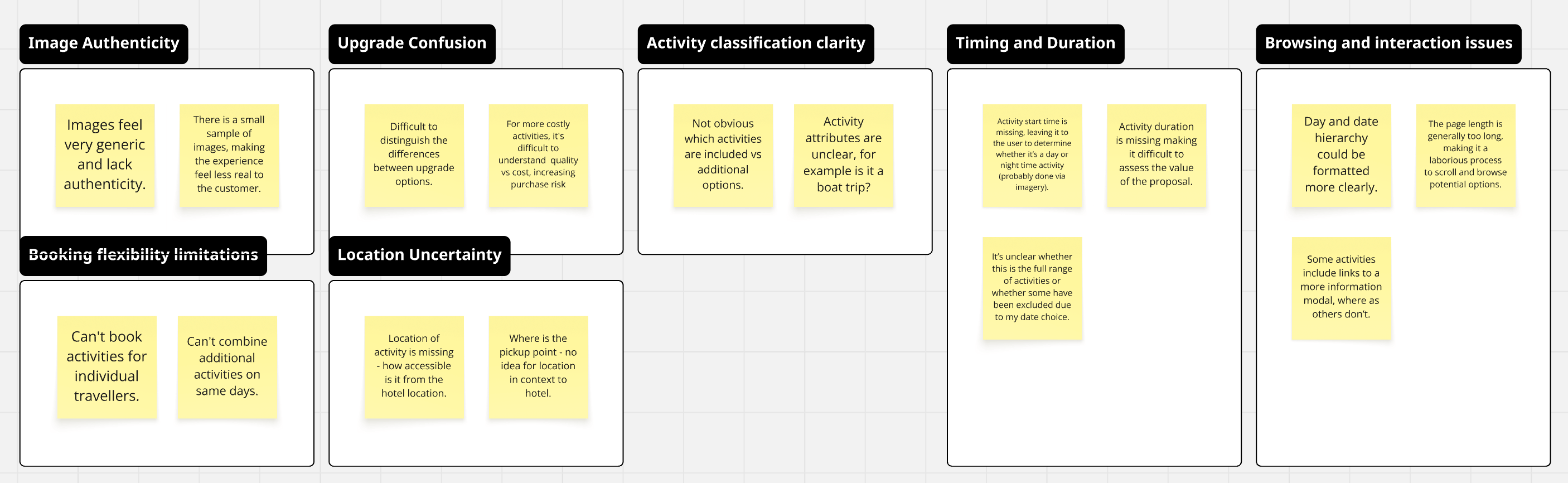
Speaking with the technical team, it became clear the underlying problem was a lack of structured data. With a third-party integration on the mid-to-long term roadmap, any design changes needed to work within the current data structure rather than rely on significant engineering effort.
Rather than pushing for a radical overhaul, we aimed for incremental buy-in from stakeholders, focusing on the following problems:
- Browsing & Interaction Issues
- Upgrade Confusion
- Lack of Timing & Duration Information
- Activity Classification Clarity
- Location Uncertainty
Design exploration

As a package traveller with a set itinerary, I need clarity on how additional activities fit into my overall schedule, so that I can choose activities confidently without overbooking myself.
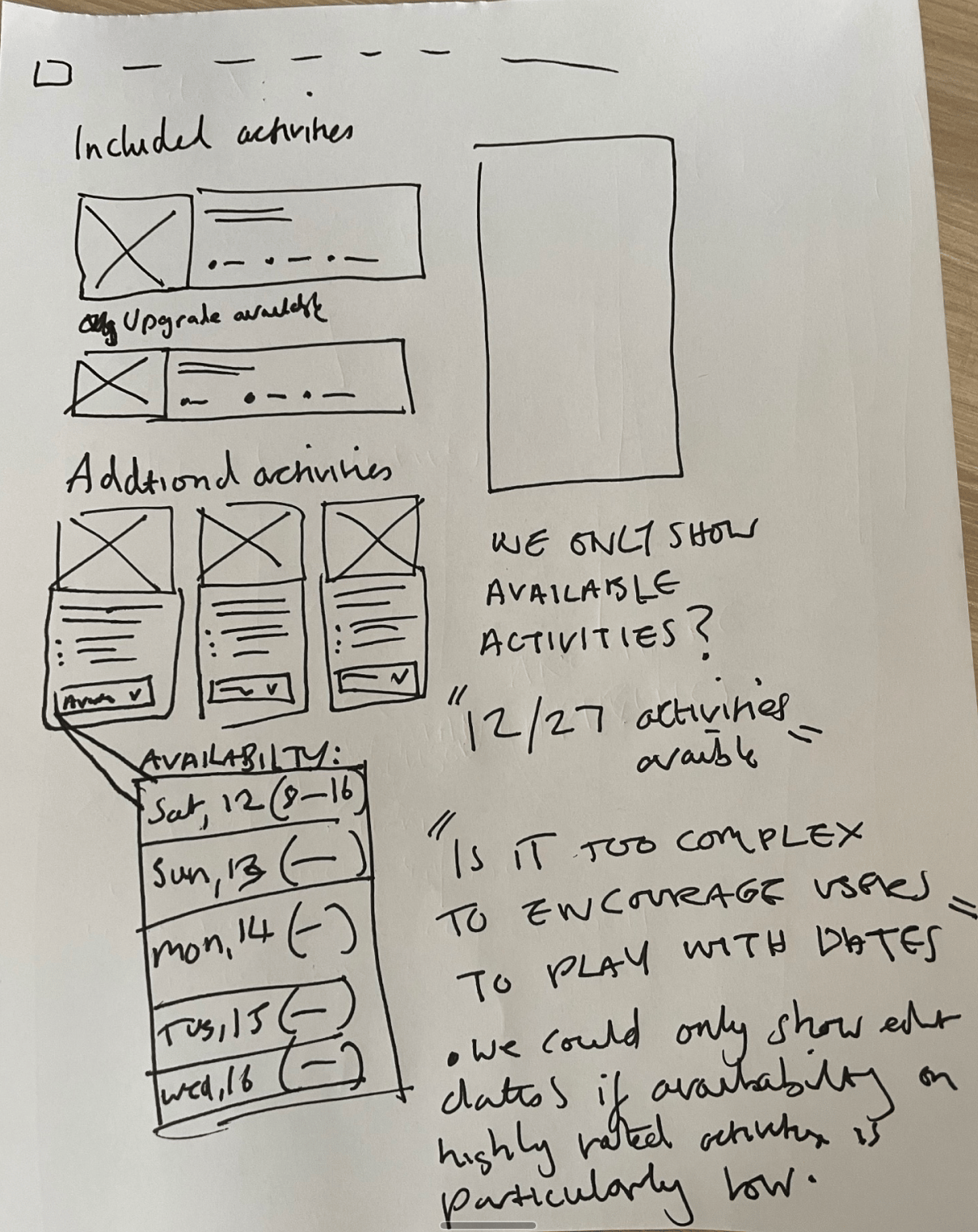
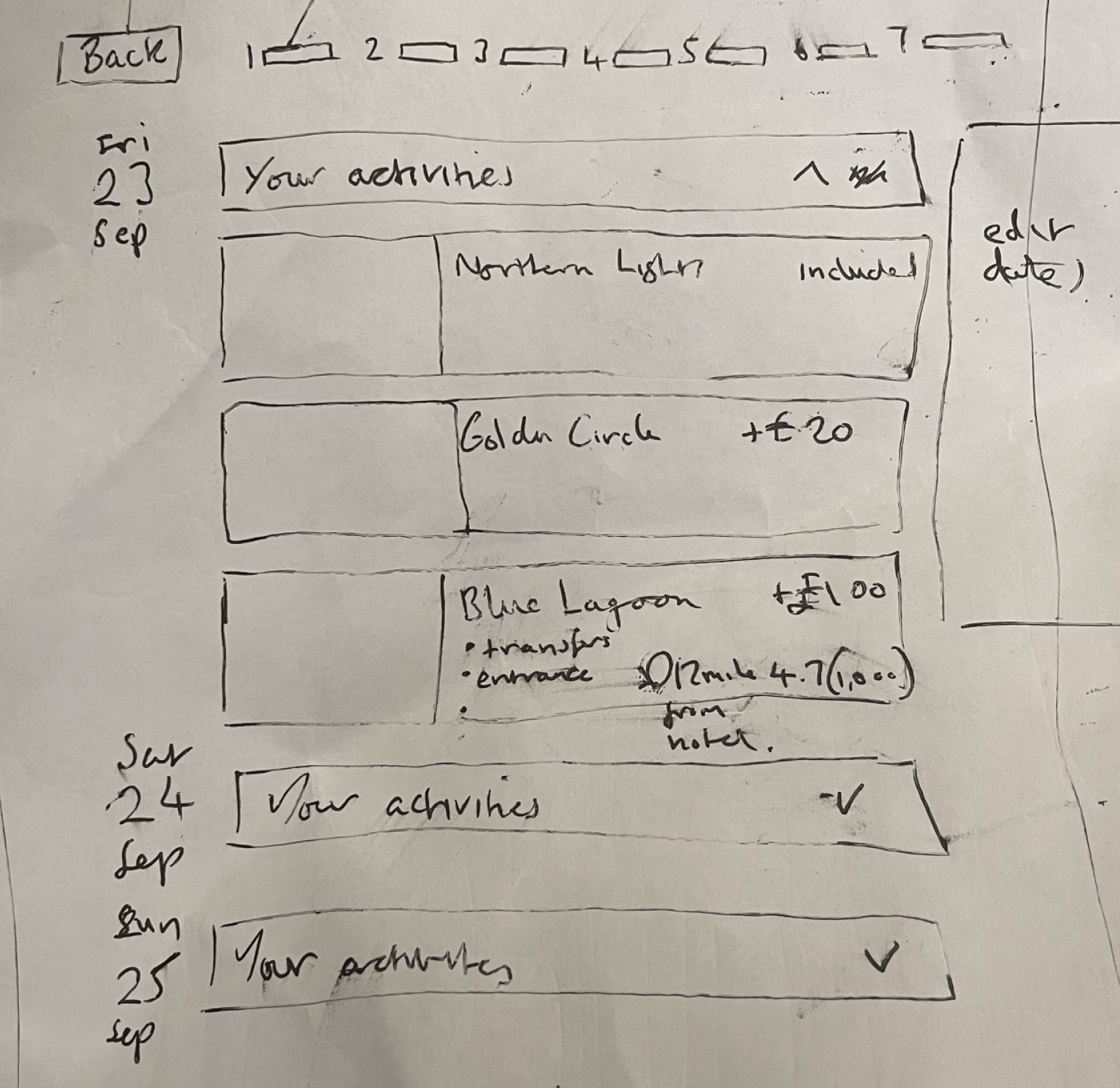
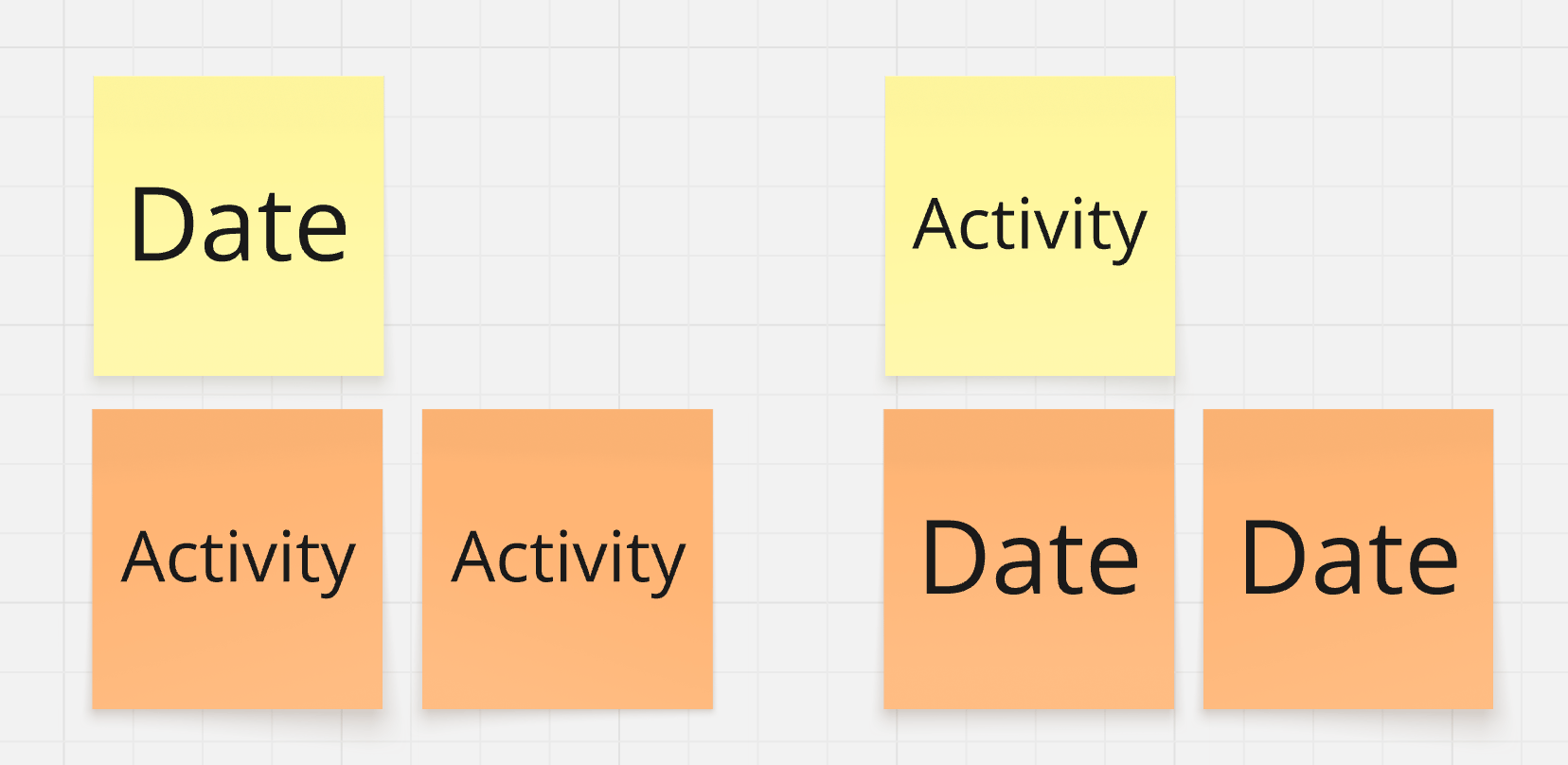
A key UX decision was the information architecture. Stakeholders wanted to lead with the full breadth of available activities, but research was clear: users care most about their itinerary and whether activities fit their schedule.
I explored an activity-first approach, but within the context of the multi-step package sales-flow, it felt overwhelming and clunky. Once stakeholders saw an activity first experience visualised within context of the sales-flow they agreed, “it felt too complex”.
Dates-first gave the decision-making process a natural structure. Users could see availability mapped across their itinerary, then choose to dive in or save a day for relaxation – offering the ideal balance.

As a value-conscious traveller, I need clear visibility of which activities are included and which are optional upgrades so that I can understand the value of my package and know how much time I have for additional activities.
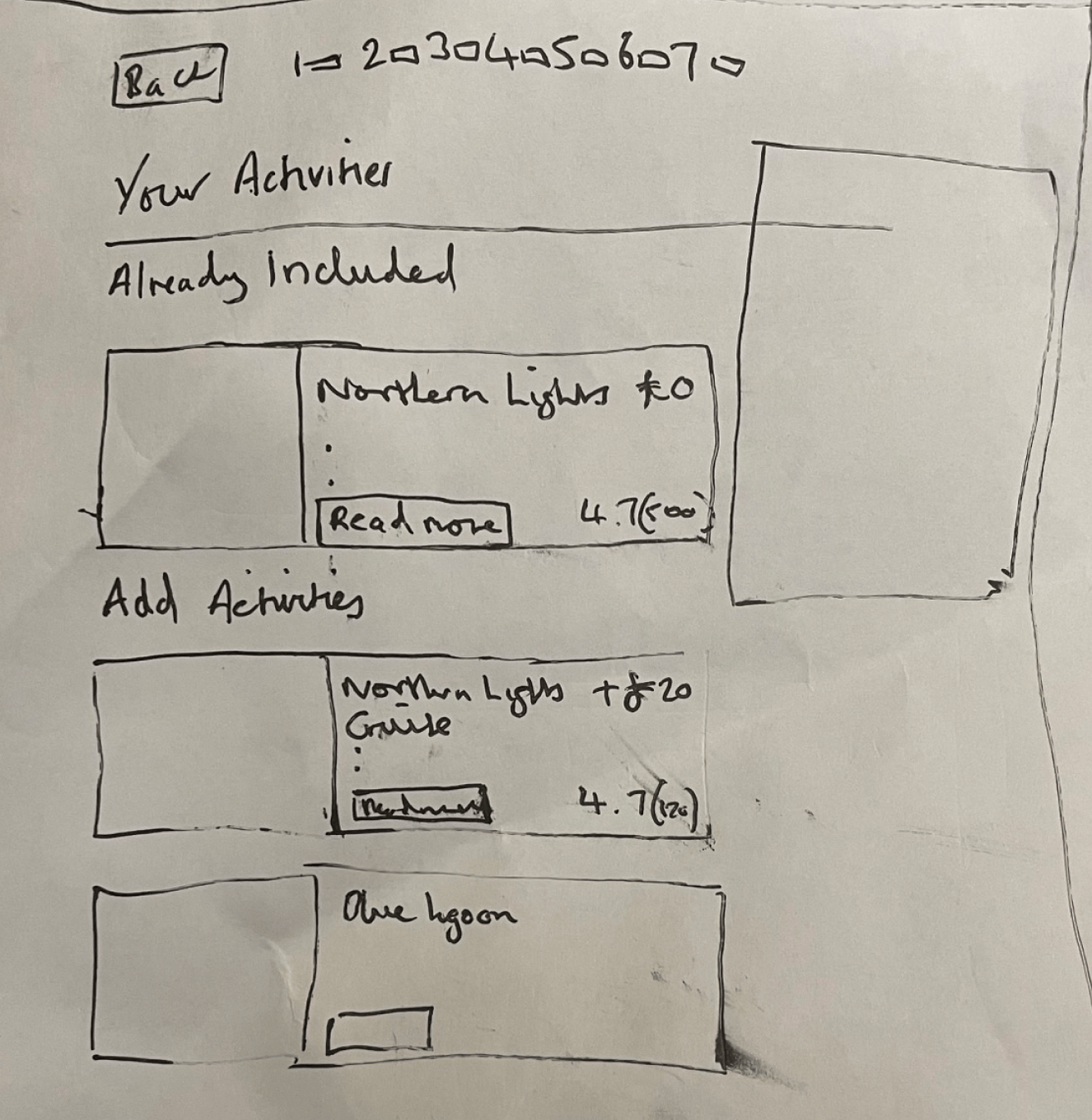
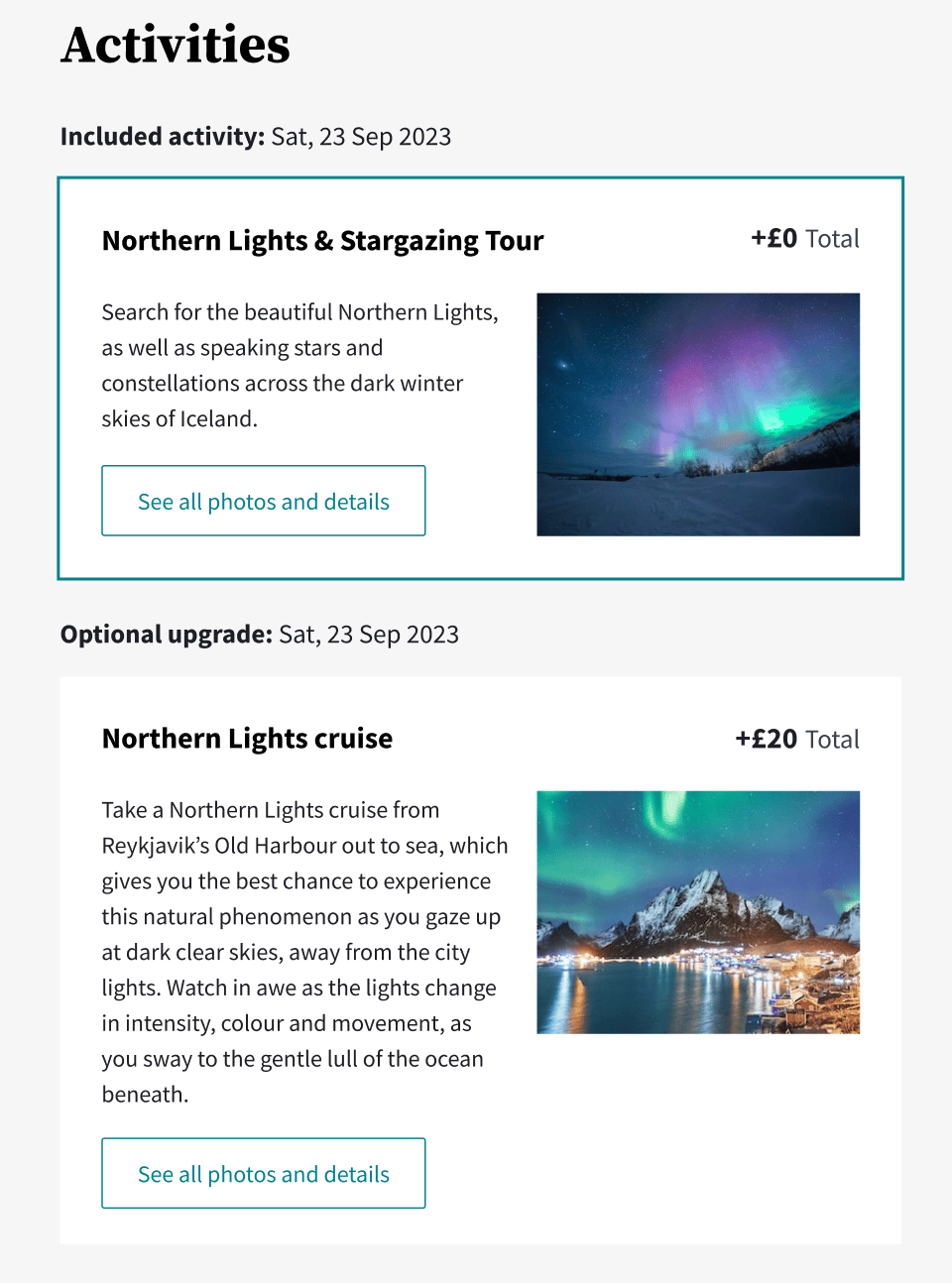
Included activities are always listed before additional activities. The previous design didn’t make it obvious as to why these activities were listed before the other options.
As we knew from the packages insight study “the experience is the hero for package holidays” - so making sure the included activities are immediately visible was important.
Rather than moving their placement, we wanted to ensure their value was clearly understood. I explored variations of label placement and wording to create clarity for users.
As a package traveller who wants a mix of rest and activity, I need clear expectations of what each activity entails, so I can curate my itinerary without over-committing.
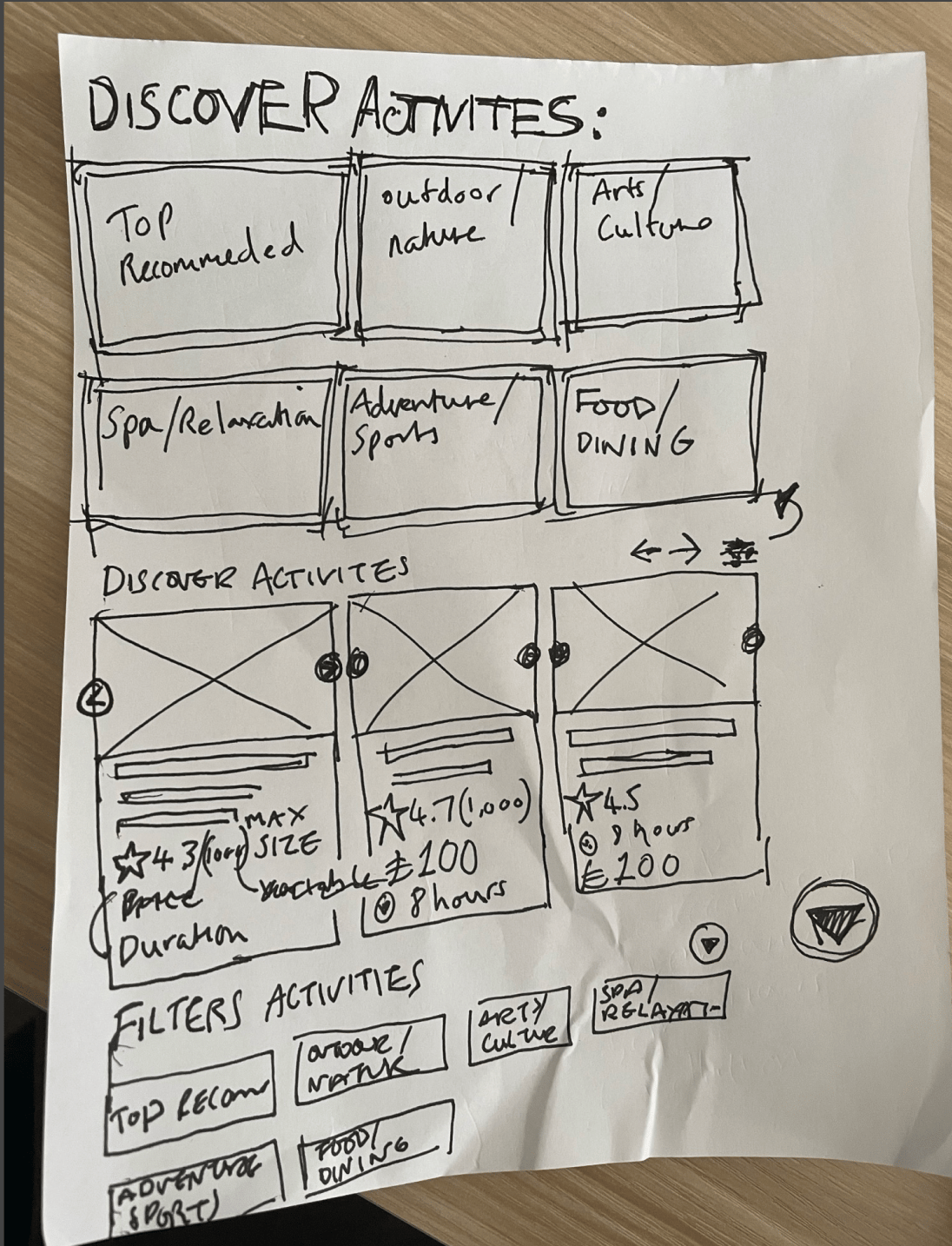
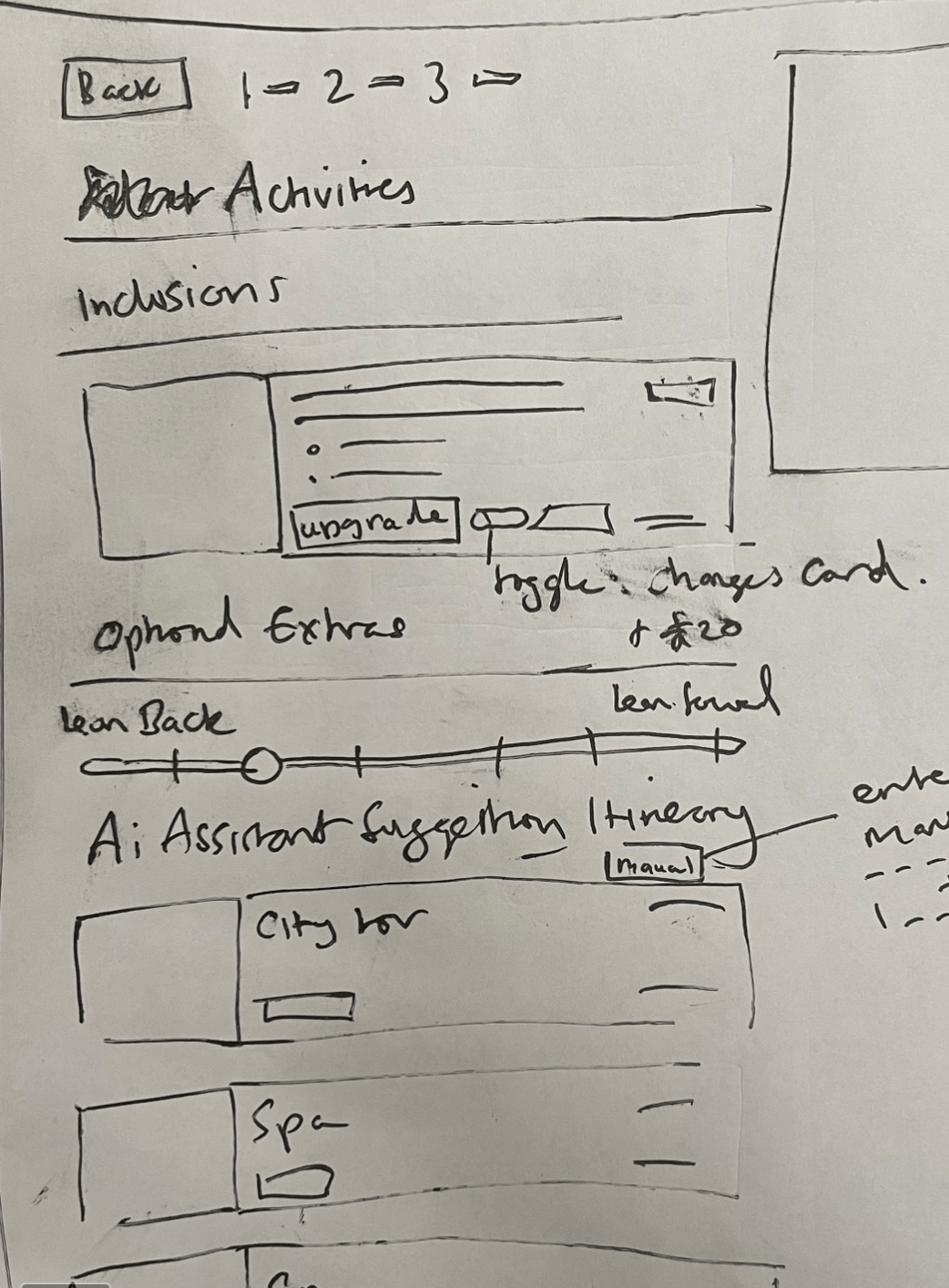
Balancing activity with rest is dynamic and can't always be planned in advance. Within the pre-booking experience, a few approaches were considered:
- Curation – choosing a blend of activities that offer both.
- Filtering – surfacing preference data rather than assuming it.
- Relaxation slider: a control that populates the activity list based on a spectrum from active to restful.
The dates-first solution supports this too. In testing, one participant put it well: they could picture booking an activity one day, a day by the pool the next, then another activity after that. Relaxation doesn't have to be something you book.

As a value-conscious traveller, I want to know how long each activity lasts, so I can judge whether it's worth the price.
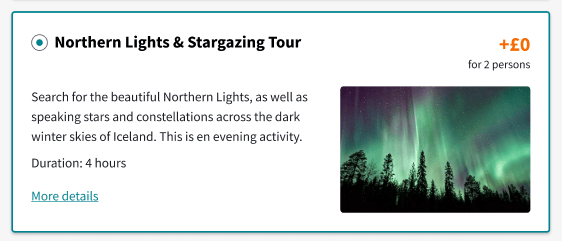
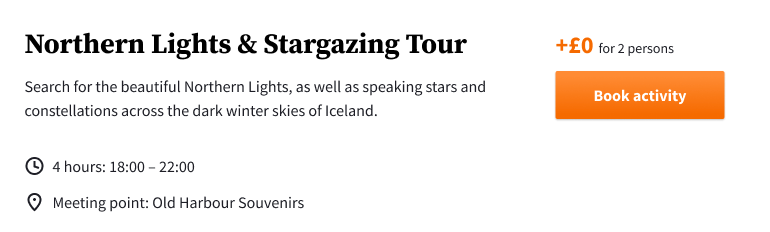
Duration was a strong user requirement. I was quite surprised that it hadn’t been picked up previously. As it’s obviously quite hard to determine the value of an activity without knowing how long it’s going to last.
Baymard Institute clearly confirmed this as a critical need for customers looking to book tours. This information needed to be visible at a card level, allowing the user to compare durations and prices simultaneously across activity options.
Concept validation
Usability testing
I ran unmoderated user testing using desktop and mobile prototypes. The feedback was positive. The dates-first format landed well on both platforms, with users describing it as intuitive, comparing it to a calendar or itinerary builder. Activity detail modals were easy to navigate and the list-based format was well liked. Duration proved critical: users consistently referenced it alongside price to judge value for money. Strong photography also had a noticeable impact on desirability, with several participants commenting that imagery alone made them want to book.
The solution
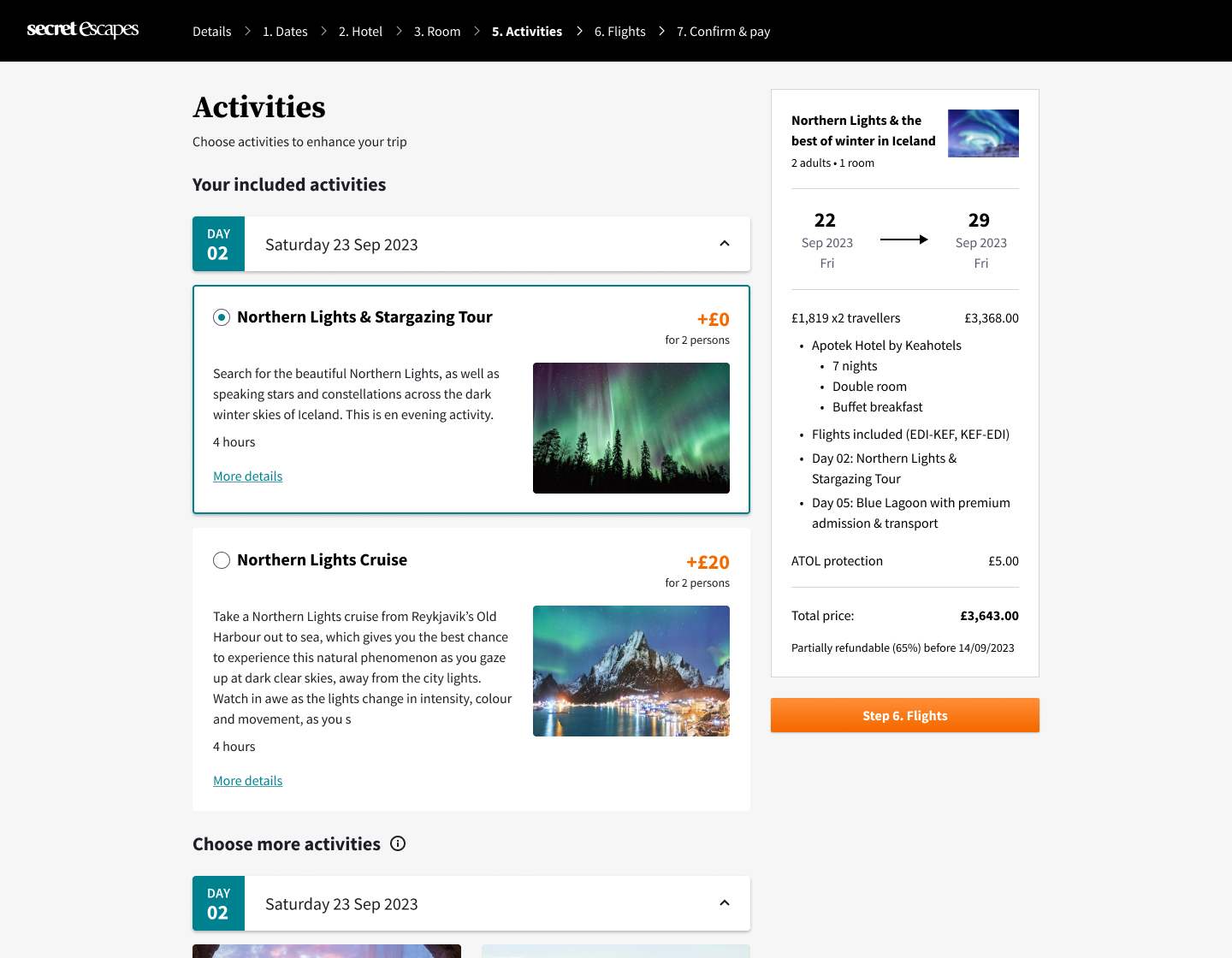
What was shipped
- Included & Optional section titles to distinguish deal inclusions
- Keeping the date first format, but making dates expandable - which allowed us to add more 2 more activities to each day without overwhelming the user.
- Added more structured information: Duration, Start- and End-time, and Type and Size of activity (group vs individual).
- Improved editorial template to make "additional information" better structured and more exciting for the user.
Outcomes
The redesign launched in Autumn 2023, just ahead of the busy booking period for the popular Iceland package deal. Tracking tech constraints meant average attachment rate couldn’t be tracked. Instead, I launched an on page Hotjar survey to capture feedback and sentiment, which received over 1,500 responses.
77%
of respondents said they had all the information they needed
4.2/5
was the average rating for how easy users described finding activities
4.2/5
was the average rating for how satisfied users were with the available activities


Package Activities
My role
Platforms
Web (Desktop & Mobile)
Team
Package Holidays
Role
Research & Product Design
Timeline
June – August 2023
Goals & Metrics

Give customers the information they need to evaluate activities confidently and conclude their purchase decision.
Increase average order value for packages with additional activities
Discovery
Activities was one of my first projects at Secret Escapes, and being a really fun topic, I was keen to learn as much as I could!
1
Requirements gathering
- I spoke with the PM to understand the commercial context of the project, what was in scope and what we were hoping to achieve.
- I spoke with the customer service team regarding the enquries and complaints they get from members on the topic. They gave me a clear picture of the information gaps that were frustrating members and creating additional work for the business.
2
Heuristics & Guidelines
- I conducted a heuristic mark-up of the current experience, noting my observations and gut reactions to the experience.
- Baymard Institute provided useful insight into user’s expecatations, which corrleated with requirements that had come from the Customer Service team.
- I also referenced Think With Google's research on the psychology and behaviour behind e-commerce purchase decisions.
3
Secondary & Competitor research
- The Research Lead shared insight reports with me and recommended viewing recently moderated user sessions on the topic.
- I learnt that package bookers have two key drivers: lean forward (challenge, stimulation, learning) and lean back (rest, calm, escape from routine). The best itineraries balance them deliberately.
- Competitor products such as GetYourGuide, Viator, and Holibob provided an interestng benchmarking opportunity. insight into design patterns points for understanding user expectations and needs.
4
Moderated interviews
- I interviewed 5 target users to understand how they think about trip activities and what they need to make a purchase or upgrade.
- They walked me through their process of discovering and deciding on activities for a mock trip using 3 competitor products: They navigated activity selection on TripAdvisor, GetYourGuide and Expedia.
- Three consistent themes emerged:
- Personal interest drove attachment more than any other factor. When an activity matched what the participant wanted to do, they were willing to spend more.
- Duration was a proxy for value. Without it, customers couldn't assess whether an activity was worth the price or fit their plans.
- People want proof. Authentic, high-quality activity photography built confidence, and reviews provided the credibility needed to convert.
The problem space
Prioritisation
There were a lot of opportunities to improve the user experience for activity selection. current experience fell well short of what users and the industry likely considered a an activity booking experience.
I walked my product partner through the problem space, discussing each problem and note taking about the positive and negative aspects of each issue.
Out of scope
Many of the issues discovered were outside the scope of this project. Instead of losing them, I created a Google Sheet that documented all the issues I’d discovered and shared it with the PM. A useful opportunity space for another day.
Agreed scope
Speaking with the technical team, it became clear the underlying problem was a lack of structured data. With a third-party integration on the mid-to-long term roadmap, any design changes needed to work within the current data structure rather than rely on significant engineering effort.
Rather than pushing for a radical overhaul, we aimed for incremental buy-in from stakeholders, focusing on the following problems:
- Browsing & Interaction Issues
- Upgrade Confusion
- Lack of Timing & Duration Information
- Activity Classification Clarity
- Location Uncertainty
Design exploration
As a package traveller with a set itinerary, I need clarity on how additional activities fit into my overall schedule, so that I can choose activities confidently without overbooking myself.
A key UX decision was the information architecture. Stakeholders wanted to lead with the full breadth of available activities, but research was clear: users care most about their itinerary and whether activities fit their schedule.
I explored an activity-first approach, but within the context of the multi-step package sales-flow, it felt overwhelming and clunky. Once stakeholders saw an activity first experience visualised within context of the sales-flow they agreed, “it felt too complex”.
Dates-first gave the decision-making process a natural structure. Users could see availability mapped across their itinerary, then choose to dive in or save a day for relaxation – offering the ideal balance.
As a value-conscious traveller, I need clear visibility of which activities are included and which are optional upgrades so that I can understand the value of my package and know how much time I have for additional activities.
Included activities are always listed before additional activities. The previous design didn’t make it obvious as to why these activities were listed before the other options.
As we knew from the packages insight study “the experience is the hero for package holidays” - so making sure the included activities are immediately visible was important.
Rather than moving their placement, we wanted to ensure their value was clearly understood. I explored variations of label placement and wording to create clarity for users.
As a package traveller who wants a mix of rest and activity, I need clear expectations of what each activity entails, so I can curate my itinerary without over-committing.
Balancing activity with rest is dynamic and can't always be planned in advance. Within the pre-booking experience, a few approaches were considered:
- Curation – choosing a blend of activities that offer both.
- Filtering – surfacing preference data rather than assuming it.
- Relaxation slider: a control that populates the activity list based on a spectrum from active to restful.
The dates-first solution supports this too. In testing, one participant put it well: they could picture booking an activity one day, a day by the pool the next, then another activity after that. Relaxation doesn't have to be something you book.

As a value-conscious traveller, I want to know how long each activity lasts, so I can judge whether it's worth the price.
Duration was a strong user requirement. I was quite surprised that it hadn’t been picked up previously. As it’s obviously quite hard to determine the value of an activity without knowing how long it’s going to last.
Baymard Institute clearly confirmed this as a critical need for customers looking to book tours. This information needed to be visible at a card level, allowing the user to compare durations and prices simultaneously across activity options.
Concept validation
Usability testing
I ran unmoderated user testing using desktop and mobile prototypes. The feedback was positive. The dates-first format landed well on both platforms, with users describing it as intuitive, comparing it to a calendar or itinerary builder. Activity detail modals were easy to navigate and the list-based format was well liked. Duration proved critical: users consistently referenced it alongside price to judge value for money. Strong photography also had a noticeable impact on desirability, with several participants commenting that imagery alone made them want to book.
The solution
What was shipped
- Included & Optional section titles to distinguish deal inclusions
- Keeping the date first format, but making dates expandable - which allowed us to add more 2 more activities to each day without overwhelming the user.
- Added more structured information: Duration, Start- and End-time, and Type and Size of activity (group vs individual).
- Improved editorial template to make "additional information" better structured and more exciting for the user.
Outcomes
The redesign launched in Autumn 2023, just ahead of the busy booking period for the popular Iceland package deal. Tracking tech constraints meant average attachment rate couldn’t be tracked. Instead, I launched an on page Hotjar survey to capture feedback and sentiment, which received over 1,500 responses.
77%
of respondents said they had all the information they needed
4.2/5
was the average rating for how easy users described finding activities
4.2/5
was the average rating for how satisfied users were with the available activities



Package Activities
My role
Platforms
Web (Desktop & Mobile)
Team
Package Holidays
Role
Research & Product Design
Timeline
June – August 2023
Goals & Metrics
Give customers the information they need to evaluate and conclude purchase
Increase average order value for packages with additional activities
Discovery
Activities was one of my first projects at Secret Escapes, and being a really fun topic, I was keen to learn as much as I could!
1
Requirements gathering
- I spoke with the PM to understand the commercial context of the project, what was in scope and what we were hoping to achieve.
- I spoke with the customer service team about the enquires and complaints they get from members, both pre & post-book. They provided a clear picture of the information gaps that were frustrating members and creating additional work for their team.
2
Heuristics & Guidelines
- I conducted a heuristic mark-up of the current experience, noting my observations and gut reactions to the experience.
- Baymard Institute provided useful insight into user’s expectations, correlating with what the customer service team had shared.
- Think With Google's research on the psychology and behaviour behind e-commerce purchase decisions was also an interesting reference.
3
Secondary & Competitor research
- The Research Lead shared insight reports with me and recommended viewing recently moderated user sessions on the topic.
- I learnt that package bookers have two key drivers: lean forward (challenge, stimulation, learning) and lean back (rest, calm, escape from routine). The best itineraries balance them deliberately.
- Specialist activity products such as GetYourGuide, Viator, and Holibob offered useful references for what a good experience could look like.
4
Moderated interviews
- I interviewed 5 target users to understand how they think about trip activities and what they need to make a purchase or upgrade.
- They walked me through their process of discovering and deciding on activities for a mock trip using 3 competitor products: They navigated activity selection on TripAdvisor, GetYourGuide and Expedia.
- Three consistent themes emerged:
- Personal interest drove attachment more than any other factor. When an activity matched what the participant wanted to do, they were willing to spend more.
- Duration was a proxy for value. Without it, customers couldn't assess whether an activity was worth the price or fit their plans.
- People want proof. Authentic, high-quality activity photography built confidence, and reviews provided the credibility needed to convert.
The problem space
Prioritisation
There were a lot of opportunities to improve the user experience for activity selection. current experience fell well short of what users and the industry likely considered a an activity booking experience.
I walked my product partner through the problem space, discussing each problem and note taking about the positive and negative aspects of each issue.
Out of scope
Many of the issues discovered were outside the scope of this project. Instead of losing them, I created a Google Sheet that documented all the issues I’d discovered and shared it with the PM. A useful opportunity space for another day.
Agreed scope
Speaking with the technical team, it became clear the underlying problem was a lack of structured data. With a third-party integration on the mid-to-long term roadmap, any design changes needed to work within the current data structure rather than rely on significant engineering effort.
Rather than pushing for a radical overhaul, we aimed for incremental buy-in from stakeholders, focusing on the following problems:
- Browsing & Interaction Issues
- Upgrade Confusion
- Lack of Timing & Duration Information
- Activity Classification Clarity
- Location Uncertainty
Design exploration
As a package traveller with a set itinerary, I need clarity on how additional activities fit into my overall schedule, so that I can choose activities confidently without overbooking myself.
A key UX decision was the information architecture. Stakeholders wanted to lead with the full breadth of available activities, but research was clear: users care most about their itinerary and whether activities fit their schedule.
I explored an activity-first approach, but within the context of the multi-step package sales-flow, it felt overwhelming and clunky. Once stakeholders saw an activity first experience visualised within context of the sales-flow they agreed, “it felt too complex”.
Dates-first gave the decision-making process a natural structure. Users could see availability mapped across their itinerary, then choose to dive in or save a day for relaxation – offering the ideal balance.
As a value-conscious traveller, I need clear visibility of which activities are included and which are optional upgrades so that I can understand the value of my package and know how much time I have for additional activities.
Included activities are always listed before additional activities. The previous design didn’t make it obvious as to why these activities were listed before the other options.
As we knew from the packages insight study “the experience is the hero for package holidays” - so making sure the included activities are immediately visible was important.
Rather than moving their placement, we wanted to ensure their value was clearly understood. I explored variations of label placement and wording to create clarity for users.
As a package traveller who wants a mix of rest and activity, I need clear expectations of what each activity entails, so I can curate my itinerary without over-committing.
Balancing activity with rest is dynamic and can't always be planned in advance. Within the pre-booking experience, a few approaches were considered:
- Curation – choosing a blend of activities that offer both.
- Filtering – surfacing preference data rather than assuming it.
- Relaxation slider: a control that populates the activity list based on a spectrum from active to restful.
The dates-first solution supports this too. In testing, one participant put it well: they could picture booking an activity one day, a day by the pool the next, then another activity after that. Relaxation doesn't have to be something you book.
As a value-conscious traveller, I want to know how long each activity lasts, so I can judge whether it's worth the price.
Duration was a strong user requirement. I was quite surprised that it hadn’t been picked up previously. As it’s obviously quite hard to determine the value of an activity without knowing how long it’s going to last.
Baymard Institute clearly confirmed this as a critical need for customers looking to book tours. This information needed to be visible at a card level, allowing the user to compare durations and prices simultaneously across activity options.
Concept validation
Usability testing
I ran unmoderated user testing using desktop and mobile prototypes. The feedback was positive. The dates-first format landed well on both platforms, with users describing it as intuitive, comparing it to a calendar or itinerary builder. Activity detail modals were easy to navigate and the list-based format was well liked. Duration proved critical: users consistently referenced it alongside price to judge value for money. Strong photography also had a noticeable impact on desirability, with several participants commenting that imagery alone made them want to book.
The solution
What was shipped
- Included & Optional section titles to distinguish deal inclusions
- Keeping the date first format, but making dates expandable - which allowed us to add more 2 more activities to each day without overwhelming the user.
- Added more structured information: Duration, Start- and End-time, and Type and Size of activity (group vs individual).
- Improved editorial template to make "additional information" better structured and more exciting for the user.
Outcomes
The redesign launched in Autumn 2023, just ahead of the busy booking period for the popular Iceland package deal. Tracking tech constraints meant average attachment rate couldn’t be tracked. Instead, I launched an on page Hotjar survey to capture feedback and sentiment, which received over 1,500 responses.
77%
of respondents said they had all the information they needed
4.2/5
was the average rating for how easy users described finding activities
4.2/5
was the average rating for how satisfied users were with the available activities