

Back to projects

Integrating third-party hotel supply into search results to increase booking frequency
Background
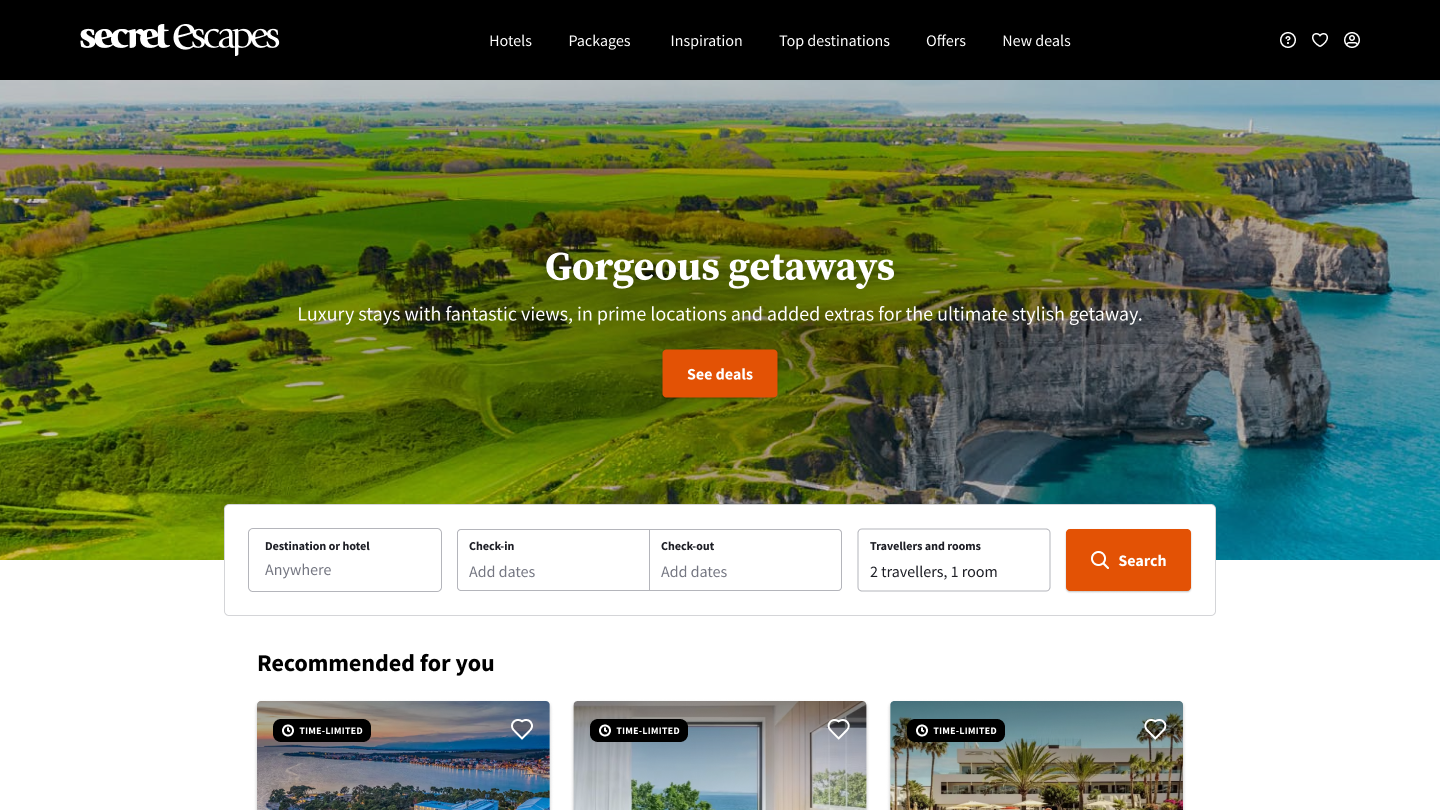
Secret Escapes is an online travel agent selling curated hotel and package deals. Its model centres on a high-frequency email channel reaching a large opted-in membership with inventory manually loaded across three primary supply channels.
😭
Opportunity
Secret Escapes is unable to serve the majority of members’ travel occasions, due to limited inventory and availability
- Members booked just ~1x a year on average
- 1/6 search sessions returned 0 results
- 1/2 of searches returned less than 10 results
- The majority of bookings were made by two traveller parties
“None of it is geared to children or families (despite the hotels offering family rooms on their own site). Such a shame as you are missing a big market here.” - Member, July 2025
Long term goals

Activate more frequent bookings from our existing member base
Attract new customer types through broader trip type availability
Hypothesis
Third-party bed banks acts as a supplementary product, filling inventory gaps in destinations where direct supply falls short, allowing Secret Escapes to serve more frequent and diverse travel needs. To test this, we launched an MVP, adding bed banks into search results and directing the user to an off-site white-label booking flow. I supported this project across all three phases: White-label, Bridging, Full API.
My role
Role
Product Design
Timeline
October 2025 – June 2026
Team
Supply Expansion Squad
Platform
Web (Desktop & Mobile) & Apps
Challenges
Stakeholder conversations had surfaced two core concerns: Bed banks needed to be credible enough to convert, whilst the performance of higher-margin direct supply is protected. The goal was to supplement, not compete with existing supply.
1
Unlike direct supply that has lead pricing – bed banks require dates to be added before pricing can be shown
How might we ensure pricing is available for bed bank deals during search?
Improve price visibility at search
Pricing is a critical requirement for user’s evaluating a purchase decision. Together with Product and Engineering we experimented with different solutions to attempt to overcome this problem.
- We ran an A/B test forcing users to add dates before searching – It showed a negative impact on conversion.
- We considered preselecting dates across all deals. This was ruled out due to high effort and API limitations.
- Eventually we landed on an on-card prompt encouraging users to add dates – communicating the reason pricing wasn’t visible whilst providing an immediate action to help the user retrieve it.
2
Stakeholders were concerned that bed bank deals could cannibalise directly contracted supply with higher profit margins
How might we elevate the value of directly contracted supply without diminishing the value of bed banks?
Protect the brand proposition
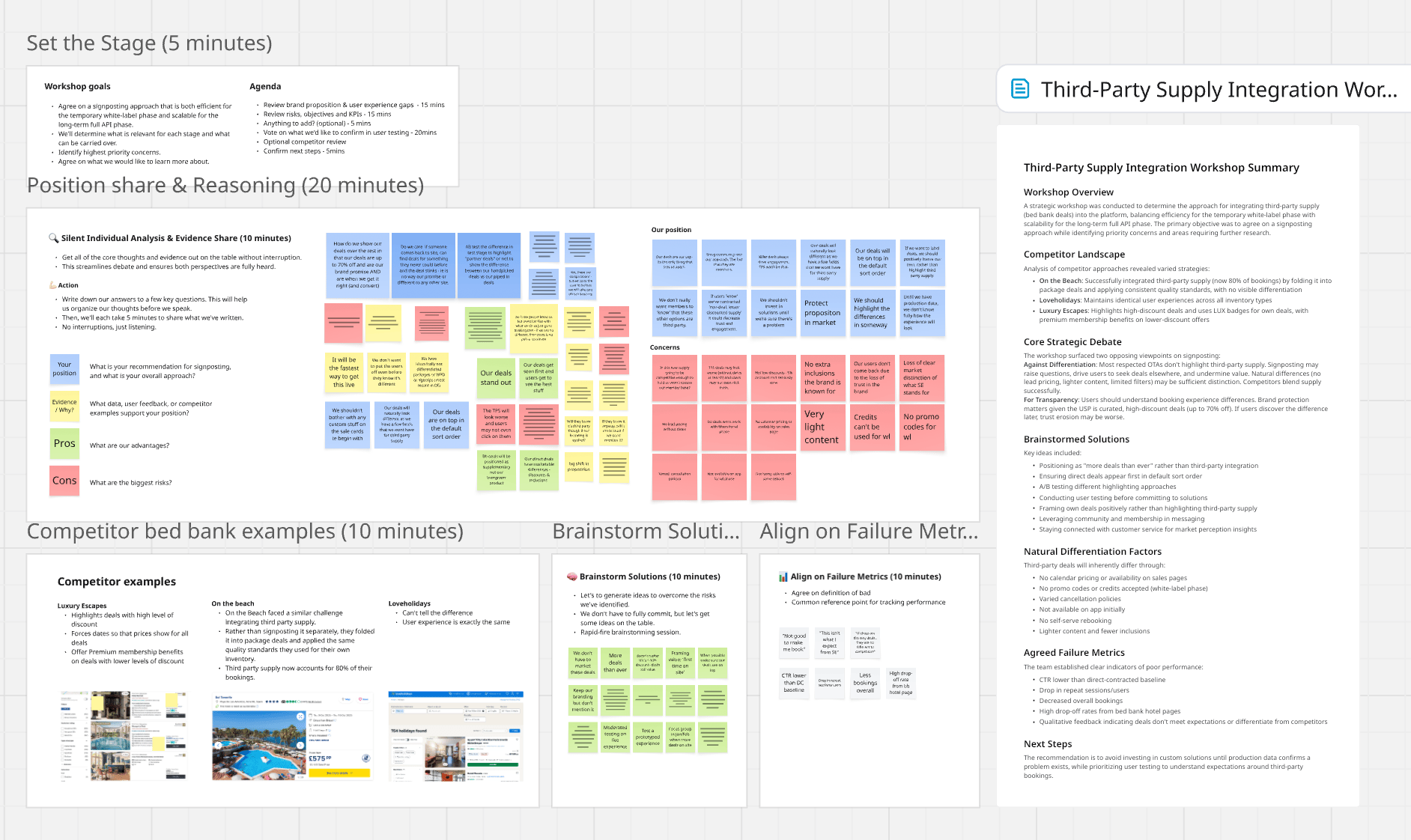
Bed bank deals didn’t align with what Secret Escapes is known for – discounts and added extras. With this difference extending throughout the booking flow, search was the best opportunity within the funnel to meaningfully shape perception. I facilitated a workshop with Brand and Product where we agreed:
- Not to signpost bed bank deals. Flagging differences risked signalling lower value before having evidence of a problem.
- Frame directly contracted deals positively rather than drawing attention to what bed bank deals lack.
Elevate directly contracted deals
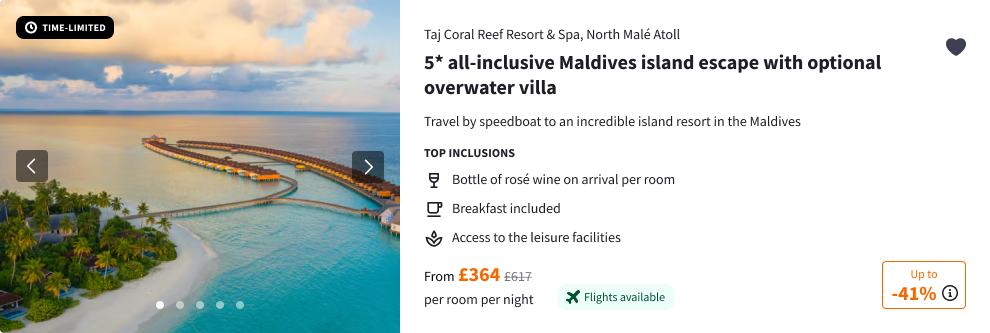
Surfacing inclusions on directly contracted deals was the clearest way to elevate their value and communicate their unique proposition. Another designer worked on the initial concept and I helped shape it in the later stages.
Stakeholders had wanted to surface inclusions for some time. This had to be done correctly, being so central to the brand’s proposition.
3
Bed bank deals lack the rich content that supports credibility and decision making
How might we bridge the trust gap between bed bank and direct supply deals and support decision making?
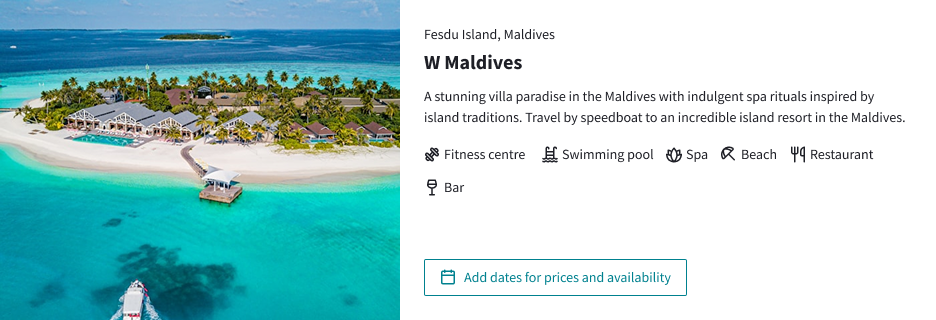
Closing the content gap
We weren’t able to utilise Expedia content for the MVP. This left bed banks feeling empty and lacking credibility, whilst being harder to evaluate.
I drew on a card sorting study I had run where participants ranked hotel attributes in order of importance: location, visual appeal, star rating, price, room types, and facilities. Facilities closed the content gap and gave members something tangible to evaluate, without distorting the perceived hierarchy between supply types.
4
Package bookings typically generate the highest margins, whilst third-party supply risks cannibalising profitability
How might we surface package deals without user's feeling their browsing intent has been hijacked?
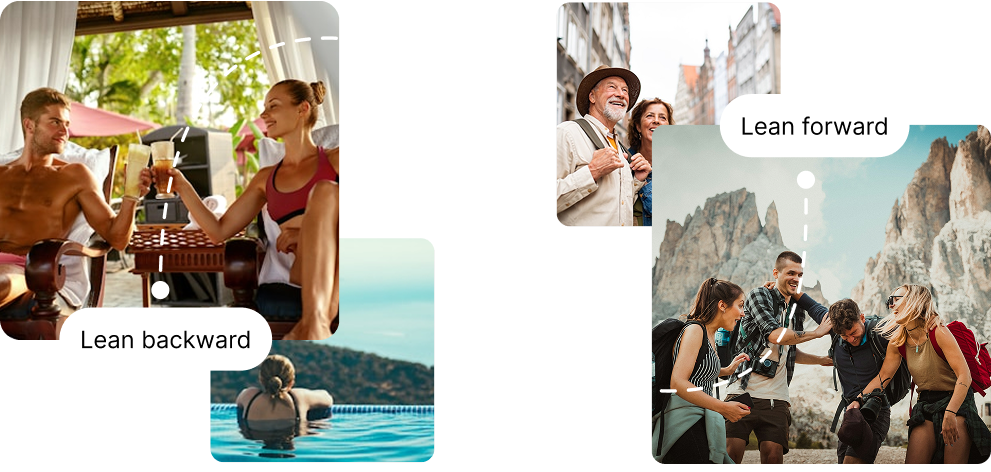
Package booker motivations
A study from showed that members want a trusted travel agent to handle the complex parts of travel. One participant expressed this clearly "I didn't have the time to plan and experts do it better". Some members described booking everything together as a trust strategy: "I book it all together so they have to take responsibility."
This makes packages a natural fit for members who want to feel like travellers, not logistics managers. The study also showed that travellers have an ideal balance of lean-back relaxation with lean-forward exploration.
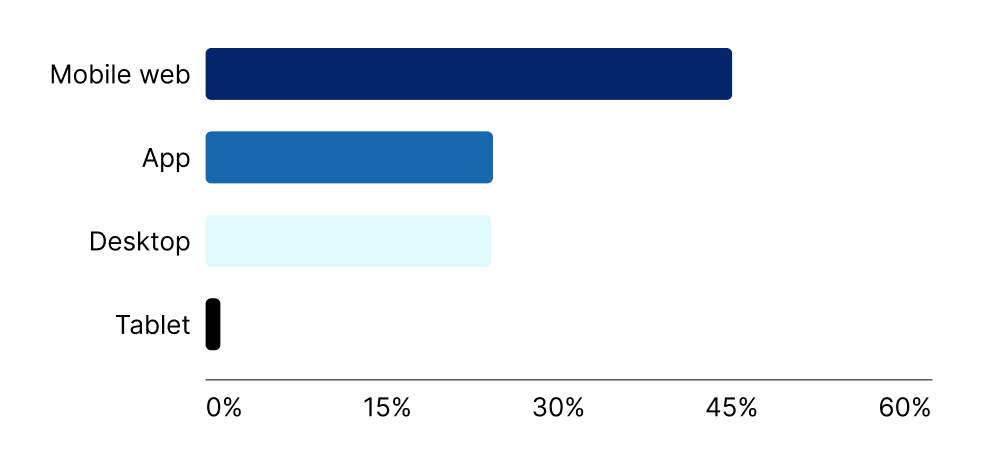
Destination first search intent
- Almost half of bookings go beyond a hotel room, suggesting members are open to more than just a room.
- In sessions where members found no hotel results, 1/5 deliberately switched to view a package deal.
- Indicating members are driven by destination, not product type.
- With the majority of search sessions happening on mobile, any solution had to work within a constrained viewport.
- On mobile web, product line navigation was hidden behind an interaction with the search field. This created friction, but also felt like a clear opportunity to improve package visibility.
Search scenarios
1/ Third-party hotels & packages available
P2/ Both hotel types & packages available
P3/ No hotels, only packages available
P4/ Only third-party hotels available
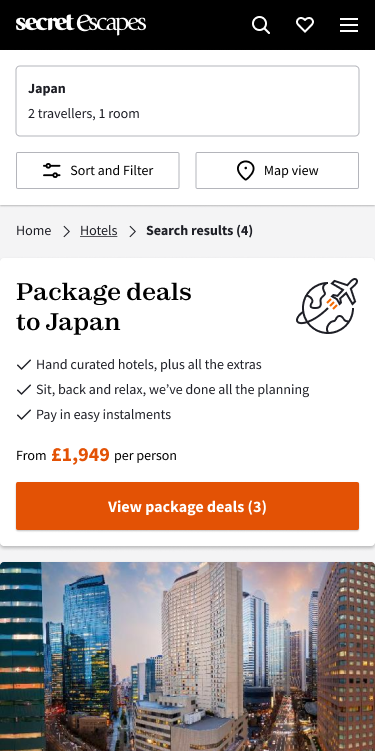
P1/ Third-party hotels & packages available
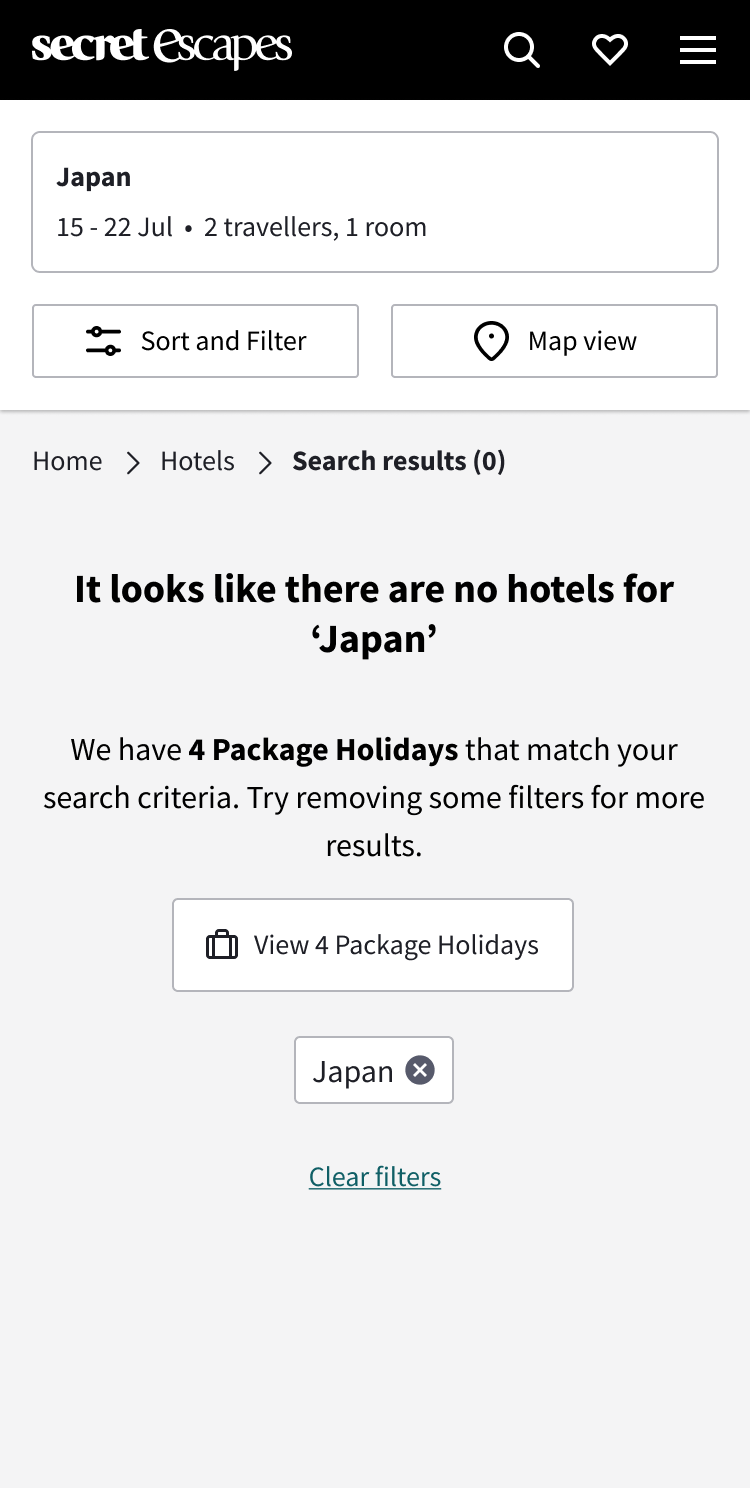
I explored several concepts, including promoting package benefits and surfacing package deals in the no-hotel-results state. A data insight showing members are destination-focused pointed toward a more active solution, so as a team, we agreed to redirect users to package results when they were available, with a message explaining why. This worked as a solution for 6 months, across 7 destinations, until bed banks were able to fill the hotel supply gaps.
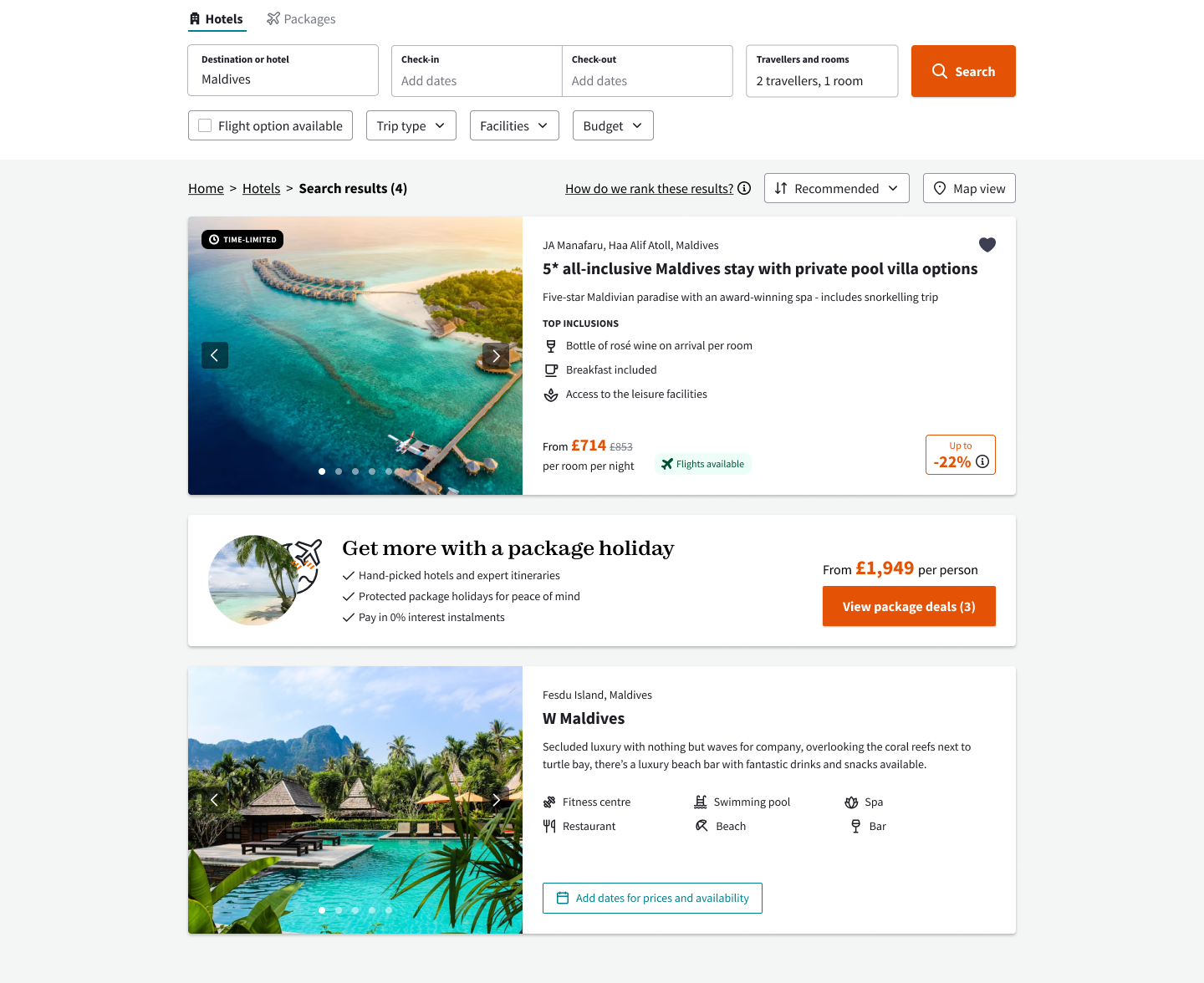
P2/ Both hotel types and packages available
- When there are directly contracted hotels available, the packages promotion follows afterwards.
- For the desktop version, we’re able to describe the benefits of packages in more detail.
- A lead image is used from the destination, alongside a flight themed graphic, indicated one of the value-based benefits of a package.
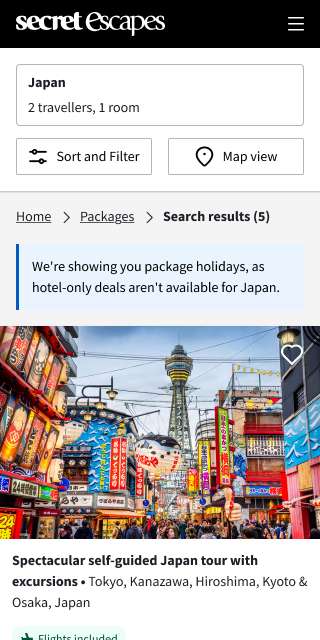
P3/ No hotels, only packages available
- I explored several concepts, including promoting package benefits and surfacing package deals in the no-hotel-results state.
- A data insight showing members are destination-focused pointed toward a more active solution, so as a team, we agreed to redirect users to package results when they were available, with a message explaining why.
- We agreed to ship and measure this solution for 6 months, across 7 destinations, until bed banks were able to fill the hotel supply gaps.
Evaluation & Refinement
Feedback from users & stakeholders
I ran unmoderated user testing to understand how users felt about the cross-sell appearing in hotel results and it’s usability. I learnt:
- Participants appreciated the recommendation in a low-hotel, long-haul scenario – Japan in this case.
- They liked that the general benefits of packages were highlighted but wanted to know more about the specific inclusions for the destination.
- Most participants couldn't find their way back to hotel results after clicking through to packages, suggesting the missing navigation was creating friction.
I had the opportunity to present these concepts to the CEO and senior executives. They were well received with the CEO noting that the packages cross-sell banner should remain visible even as hotel-only supply scales. The Commercial Director highlighted the value of surfacing deal-specific attributes in search results, aligning with both member and business goals.
Refining the designs
An internal concern was deal visibility as on card content was added, as well as banners and additions to the UI. To address this, I reduced the mobile banner content to just focus on the title and CTA. I worked with an engineering partner to update search UI behaviour, to make it more intuitive to user’s search goals, and to create a larger area of visibility.
- Banner appears across all destinations, after the third hotel card, as long as there’s least 2 packages available.
- Headline reframed as a promotion rather than a recommendation.
- Graphic updated to accommodate broader destination imagery.
Demand for packages increased, which meant adjusting banner logic:
- Banner appears across all destinations, after the third hotel card, as long as there’s least 2 packages available.
- Headline reframed as a promotion rather than a recommendation.
- Graphic updated to accommodate broader destination imagery.
Collaborating with the app team
I explored the possibilities and technical constraints with the apps team, discussing how user’s would be able to move between hotel and package result during the search experience.
We discussed a few different UX approaches and agreed that the best balance of effort and impact would be to trigger a fresh package search when the user taps the banner. This introduced some edge cases – such as what happens when packages aren't available, or when certain search filters can't be passed across. These were accepted as workable constraints to design around rather than blockers.
With the direction agreed, I prototyped the experience and shared it with the app team and colleagues across Product and Design for feedback. I also used Claude’s in browser tool to run a heuristic analysis of the prototype, which produced some useful insights. From there, the focus shifted to working through edge cases and progressing the designs towards implementation alongside the app team.
Outcomes
Since launching, bed bank bookings grew ~10x in 3 months.
Click-through rate for bed bank deals was lower than directly contracted deals, pointing to a trust gap that still needed closing. Conversion also sat lower than directly contracted deals, and even lower still when both hotel types sat side by side. This indicated that members were still choosing to book direct supply when it was available - a positive signal regarding the cannibalisation risk.
2x
Average number of search results
-3%
Zero results for all user searches
10x
Number of hotels on site
46+
New countries added
“It just looks like a hotel price, not like a deal. Maybe I could get the same deal on Booking.com. I feel it's losing whatever the USP is of Secret Escapes.”
“It's confusing having two very different ways hotels are displayed. One is spot on, the other just looks worse in pretty much every way."
"I find the facilities icons really helpful. But why didn't you show the facilities in the first few results either? I thought they would all be the same."
Next steps
The quantitative data looked optimistic. In one of our primary regions, bed bank supply was performing well, filling gaps where directly contracted hotels fell short. But the qualitative feedback told a more complicated story: the trust gap remained exposed through inconsistent page design, missing value signals, and content that hadn't yet been brought close enough to the Secret Escapes brand standard.
The MVP had done its job, but retaining users as bed bank supply scales would need more than the whitelabel model could offer. Stakeholders were keen to move to the full API phase as quickly as possible, to close the trust gap, improve the booking flow, bring the product closer to the brand, and reduce the cost of running on a whitelabel model.
Cost was one of the more immediate problems. API costs from the whitelabel integration were running higher than expected, so I worked with Product and Engineering to find UX changes that could bring costs down without compromising the experience. I led a workshop with the apps team to explore solutions within the context of their own constraints, using prototypes to bring the proposal to life.
Back to projects
Integrating third-party hotel supply into search results to increase booking frequency
Background
Secret Escapes is an online travel agent selling curated hotel and package deals. Its model centres on a high-frequency email channel reaching a large opted-in membership with inventory manually loaded across three primary supply channels.
😭
Opportunity
Secret Escapes is unable to serve the majority of members’ travel occasions, due to limited inventory and availability
- Members booked just ~1x a year on average
- 1/6 search sessions returned 0 results
- 1/2 of searches returned less than 10 results
- The majority of bookings were made by two traveller parties
“None of it is geared to children or families (despite the hotels offering family rooms on their own site). Such a shame as you are missing a big market here.” - Member, July 2025
Long term goals
Activate more frequent bookings from our existing member base
Attract new customer types through broader trip type availability
Hypothesis
Third-party bed banks acts as a supplementary product, filling inventory gaps in destinations where direct supply falls short, allowing Secret Escapes to serve more frequent and diverse travel needs. To test this, we launched an MVP, adding bed banks into search results and directing the user to an off-site white-label booking flow. I supported this project across all three phases
My role
Role
Product Design
Timeline
October 2025 – June 2026
Team
Supply Expansion Squad
Platform
Web (Desktop & Mobile) & Apps
Challenges
Stakeholder conversations had surfaced two core concerns: Bed banks needed to be credible enough to convert, whilst the performance of higher-margin direct supply is protected. The goal was to supplement, not compete with existing supply.
1
Unlike direct supply that has lead pricing – bed banks require dates to be added before pricing can be shown
How might we ensure pricing is available for bed bank deals during search?
Improve price visibility at search
Pricing is a critical requirement for user’s evaluating a purchase decision. Together with Product and Engineering we experimented with different solutions to attempt to overcome this problem.
- We ran an A/B test forcing users to add dates before searching – It showed a negative impact on conversion.
- We considered preselecting dates across all deals. This was ruled out due to high effort and API limitations.
- Eventually we landed on an on-card prompt encouraging users to add dates – communicating the reason pricing wasn’t visible whilst providing an immediate action to help the user retrieve it.
2
Stakeholders were concerned that bed bank deals could cannibalise directly contracted supply with higher profit margins
How might we elevate the value of directly contracted supply without diminishing bed banks?
Protect the brand proposition
Bed bank deals don’t align with what Secret Escapes is known for – discounts and added extras. With this difference extending throughout the booking flow, search was the best opportunity within the funnel to meaningfully shape perception. We agreed:
- Don't signpost bed bank deals. Flagging differences risks signalling lower value before we have evidence of a problem.
- Frame directly contracted deals positively rather than drawing attention to what bed bank deals lack.
Elevate directly contracted deals
Surfacing inclusions on directly contracted deals was the clearest way to elevate their value and communicate their unique proposition. I helped shape the later stages of this concept.
Stakeholders had wanted to surface inclusions for some time. This had to be done correctly, being so central to the brand’s proposition.
3
Bed bank deals lack the rich content that supports credibility and decision making
How might we bridge the trust gap between bed bank and direct supply deals and support decision making?
Close the content gap
We weren’t able to utilise Expedia content for the MVP. This left bed banks feeling empty and lacking credibility, whilst being harder to evaluate.
I drew on a card sorting study I had run where participants ranked hotel attributes in order of importance: location, visual appeal, star rating, price, room types, and facilities. Facilities closed the content gap and gave members something tangible to evaluate, without distorting the perceived hierarchy between supply types.
4
Package bookings typically generate the highest margins, whilst third-party supply risks cannibalising profitability.
How might we surface package deals without user's feeling their browsing intent has been hijacked?
Package booker motivations
A study from showed that members want a trusted travel agent to handle the complex parts of travel. One participant expressed this clearly "I didn't have the time to plan and experts do it better". Some members described booking everything together as a trust strategy: "I book it all together so they have to take responsibility."
This makes packages a natural fit for members who want to feel like travellers, not logistics managers. The study also showed that travellers have an ideal balance of lean-back relaxation with lean-forward exploration.
Destination first search intent
- Almost half of bookings go beyond a hotel room, suggesting members are open to more than just a room.
- In sessions where members found no hotel results, 1/5 deliberately switched to view a package deal.
- Indicating members are driven by destination, not product type.
- With the majority of search sessions happening on mobile, any solution had to work within a constrained viewport.
- On mobile web, product line navigation was hidden behind an interaction with the search field. This created friction, but also felt like a clear opportunity to improve package visibility.
Search scenarios
P1/ Third-party hotels & packages available
P2/ Both hotel types & packages available
P3/ No hotels, only packages available
P4/ Only third-party hotels available
P1/ Third-party hotels & packages available
- An inline banner felt like a confident and intentional solution to recommend packages within for certain destinations.
- The content aimed to educate members on the benefits of a package booking, aligning with key drivers: convenience, trust, and value.
- We would target destinations where a package booking could offer real cost savings or an itinerary is the recommended experience.
- Content was minimised for the mobile version to keep it’s height to a minimum.
- A member of the Editorial team helped me refine the final for the banner, which took a more promotional tone.
P2/ Both hotel types and packages available
- When there are directly contracted hotels available, the packages promotion follows afterwards.
- For the desktop version, we’re able to describe the benefits of packages in more detail.
- A lead image is used from the destination, alongside a flight themed graphic, indicated one of the value-based benefits of a package.
P3/ No hotels, only packages available
- I explored several concepts, including promoting package benefits and surfacing package deals in the no-hotel-results state.
- A data insight showing members are destination-focused pointed toward a more active solution, so as a team, we agreed to redirect users to package results when they were available, with a message explaining why.
- We agreed to ship and measure this solution for 6 months, across 7 destinations, until bed banks were able to fill the hotel supply gaps.
Evaluation & Refinement
Feedback from users & stakeholders
I ran unmoderated user testing to understand how users felt about the cross-sell appearing in hotel results and it’s usability. I learnt:
- Participants appreciated the recommendation in a low-hotel, long-haul scenario – Japan in this case.
- They liked that the general benefits of packages were highlighted but wanted to know more about the specific inclusions for the destination.
- Most participants couldn't find their way back to hotel results after clicking through to packages, suggesting the missing navigation was creating friction.
I had the opportunity to present these concepts to the CEO and senior executives. They were well received with the CEO noting that the packages cross-sell banner should remain visible even as hotel-only supply scales. The Commercial Director highlighted the value of surfacing deal-specific attributes in search results, aligning with both member and business goals.
Refining the designs
An internal concern was deal visibility as on card content was added, as well as banners and additions to the UI. To address this, I reduced the mobile banner content to just focus on the title and CTA. I worked with an engineering partner to update search UI behaviour, to make it more intuitive to user’s search goals, and to create a larger area of visibility.
- Banner appears across all destinations, after the third hotel card, as long as there’s least 2 packages available.
- Headline reframed as a promotion rather than a recommendation.
- Graphic updated to accommodate broader destination imagery.
Demand for packages increased, which meant adjusting banner logic:
- Banner appears across all destinations, after the third hotel card, as long as there’s least 2 packages available.
- Headline reframed as a promotion rather than a recommendation.
- Graphic updated to accommodate broader destination imagery.
Collaborating with the app team
I explored the possibilities and technical constraints with the apps team, discussing how user’s would be able to move between hotel and package result during the search experience.
We discussed a few different UX approaches and agreed that the best balance of effort and impact would be to trigger a fresh package search when the user taps the banner. This introduced some edge cases – such as what happens when packages aren't available, or when certain search filters can't be passed across. These were accepted as workable constraints to design around rather than blockers.
With the direction agreed, I prototyped the experience and shared it with the app team and colleagues across Product and Design for feedback. I also used Claude’s in browser tool to run a heuristic analysis of the prototype, which produced some useful insights. From there, the focus shifted to working through edge cases and progressing the designs towards implementation alongside the app team.
Outcomes
Since launching, bed bank bookings grew ~10x in 3 months.
Click-through rate for bed bank deals was lower than directly contracted deals, pointing to a trust gap that still needed closing. Conversion also sat lower than directly contracted deals, and even lower still when both hotel types sat side by side. This indicated that members were still choosing to book direct supply when it was available - a positive signal regarding the cannibalisation risk.
2x
Average number of search results
10x
Number of hotels on site
46+
New countries added
“It just looks like a hotel price, not like a deal. Maybe I could get the same deal on Booking.com. I feel it's losing whatever the USP is of Secret Escapes.”
“It's confusing having two very different ways hotels are displayed. One is spot on, the other just looks worse in pretty much every way."
"I find the facilities icons really helpful. But why didn't you show the facilities in the first few results either? I thought they would all be the same."
Next steps
The quantitative data looked optimistic. In one of our primary regions, bed bank supply was performing well, filling gaps where directly contracted hotels fell short. But the qualitative feedback told a more complicated story: the trust gap remained exposed through inconsistent page design, missing value signals, and content that hadn't yet been brought close enough to the Secret Escapes brand standard.
The MVP had done its job, but retaining users as bed bank supply scales would need more than the whitelabel model could offer. Stakeholders were keen to move to the full API phase as quickly as possible, to close the trust gap, improve the booking flow, bring the product closer to the brand, and reduce the cost of running on a whitelabel model.
Cost was one of the more immediate problems. API costs from the whitelabel integration were running higher than expected, so I worked with Product and Engineering to find UX changes that could bring costs down without compromising the experience. I led a workshop with the apps team to explore solutions within the context of their own constraints, using prototypes to bring the proposal to life.


Back to projects
Integrating third-party hotel supply into search results to increase booking frequency
Background
Secret Escapes is an online travel agent selling curated hotel and package deals. Its model centres on a high-frequency email channel reaching a large opted-in membership with inventory manually loaded across three primary supply channels.
Opportunity
Secret Escapes is unable to serve the majority of members’ travel occasions, due to limited inventory and availability
- Members booked just ~1x a year on average
- 1/6 search sessions returned 0 results
- 1/2 of searches returned less than 10 results
- The majority of bookings were made by two traveller parties
“None of it is geared to children or families (despite the hotels offering family rooms on their own site). Such a shame as you are missing a big market here.” - Member, July 2025
😭
Long term goals

Activate more frequent bookings from our existing member base

Attract new customer types through broader trip type availability
Hypothesis
Third-party bed banks acts as a supplementary product, filling inventory gaps in destinations where direct supply falls short. It will also provide broader and deeper inventory, appealing to new audiences.
Bed banks were introduced to search results, directing the user to a white-label booking flow. I supported this project across all phases: White-label launch, Bridging optimisations, and Full API integration.
My role
Role
Product Design
Timeline
October 2025 – June 2026
Team
Supply Expansion Squad
Platforms
Web (Desktop & Mobile) & Apps
Design challenges
Stakeholder conversations had surfaced two core concerns: Bed banks needed to be credible enough to convert, whilst the performance of higher-margin direct supply is protected. The goal was to supplement, not compete with existing supply.
1
Unlike direct supply that has lead pricing – bed banks require dates to be added before pricing can be shown
How might we ensure pricing is available for bed bank deals during search?
Improve price visibility at search
Pricing is a critical requirement for user’s evaluating a purchase decision. Together with Product and Engineering we experimented with different solutions to attempt to overcome this problem.
- We ran an A/B test forcing users to add dates before searching – It showed a negative impact on conversion.
- We considered preselecting dates across all deals. This was ruled out due to high effort and API limitations.
- Eventually we landed on an on-card prompt encouraging users to add dates – communicating the reason pricing wasn’t visible whilst providing an immediate action to help the user retrieve it.
2
Stakeholders were concerned that bed bank deals could cannibalise directly contracted supply with higher profit margins.
How might we elevate the value of directly contracted supply without diminishing bed banks?
Protect the brand proposition
Bed bank deals don’t align with what Secret Escapes is known for – discounts and added extras. With this difference extending throughout the booking flow, search was the best opportunity within the funnel to meaningfully shape perception. We agreed:
- Don't signpost bed bank deals. Flagging differences risks signalling lower value before we have evidence of a problem.
- Frame directly contracted deals positively rather than drawing attention to what bed bank deals lack.
Elevate directly contracted deals
Surfacing inclusions on directly contracted deals was the clearest way to elevate their value and communicate their unique proposition. I helped shape the later stages of this concept.
Stakeholders had wanted to surface inclusions for some time. This had to be done correctly, being so central to the brand’s proposition.
3
Bed bank deals lack the rich content that supports credibility and decision making
How might we bridge the trust gap between bed bank and direct supply deals and support decision making?
Closing the content gap
We weren’t able to utilise Expedia content for the MVP. This left bed banks feeling empty and lacking credibility, whilst being harder to evaluate.
I drew on a card sorting study I had run where participants ranked hotel attributes in order of importance: location, visual appeal, star rating, price, room types, and facilities. Facilities closed the content gap and gave members something tangible to evaluate, without distorting the perceived hierarchy between supply types.
4
Package bookings typically generate the highest margins, whilst third-party supply risks cannibalising profitability.
How might we surface package deals without user's feeling their browsing intent has been hijacked?
Package booker motivations
A study from showed that members want a trusted travel agent to handle the complex parts of travel. One participant expressed this clearly "I didn't have the time to plan and experts do it better". Some members described booking everything together as a trust strategy: "I book it all together so they have to take responsibility."
This makes packages a natural fit for members who want to feel like travellers, not logistics managers. The study also showed that travellers have an ideal balance of lean-back relaxation with lean-forward exploration.
Destination first search intent
- Almost half of bookings go beyond a hotel room, suggesting members are open to more than just a room.
- In sessions where members found no hotel results, 1/5 deliberately switched to view a package deal.
- Indicating members are driven by destination, not product type.
- With the majority of search sessions happening on mobile, any solution had to work within a constrained viewport.
- On mobile web, product line navigation was hidden behind an interaction with the search field. This created friction, but also felt like a clear opportunity to improve package visibility.
Search scenario exploration
P1/ Third-party hotels & packages available
P2/ Both hotel types & packages available
P3/ No hotels, only packages available
P4/ Only third-party hotels available
P1/ Third-party hotels & packages available
- An inline banner felt like a confident and intentional solution to recommend packages within for certain destinations.
- The content aimed to educate members on the benefits of a package booking, aligning with key drivers: convenience, trust, and value.
- We would target destinations where a package booking could offer real cost savings or an itinerary is the recommended experience.
- Content was minimised for the mobile version to keep it’s height to a minimum.
- A member of the Editorial team helped me refine the final for the banner, which took a more promotional tone.
P2/ Both hotel types and packages available
- When there are directly contracted hotels available, the packages promotion follows afterwards.
- For the desktop version, we’re able to describe the benefits of packages in more detail.
- A lead image is used from the destination, alongside a flight themed graphic, indicated one of the value-based benefits of a package.
P3/ No hotels, only packages available
- I explored several concepts, including promoting package benefits and surfacing package deals in the no-hotel-results state.
- A data insight showing members are destination-focused pointed toward a more active solution, so as a team, we agreed to redirect users to package results when they were available, with a message explaining why.
- We agreed to ship and measure this solution for 6 months, across 7 destinations, until bed banks were able to fill the hotel supply gaps.
Evaluation & Refinement
Feedback from users & stakeholders
I ran unmoderated user testing to understand how users felt about the cross-sell appearing in hotel results and it’s usability. I learnt:
- Participants appreciated the recommendation in a low-hotel, long-haul scenario – Japan in this case.
- They liked that the general benefits of packages were highlighted but wanted to know more about the specific inclusions for the destination.
- Most participants couldn't find their way back to hotel results after clicking through to packages, suggesting the missing navigation was creating friction.
I had the opportunity to present these concepts to the CEO and senior executives. They were well received with the CEO noting that the packages cross-sell banner should remain visible even as hotel-only supply scales. The Commercial Director highlighted the value of surfacing deal-specific attributes in search results, aligning with both member and business goals.
Refining the designs
An internal concern was deal visibility as on card content was added, as well as banners and additions to the UI. To address this, I reduced the mobile banner content to just focus on the title and CTA. I worked with an engineering partner to update search UI behaviour, to make it more intuitive to user’s search goals, and to create a larger area of visibility.
Demand for packages increased, which meant adjusting banner logic:
- Banner appears across all destinations, after the third hotel card, as long as there’s least 2 packages available.
- Headline reframed as a promotion rather than a recommendation.
- Graphic updated to accommodate broader destination imagery.
- Product type navigation should be added to the mobile web experience.
Collaborating with the app team
I explored the concepts and technical constraints with the apps team, discussing how user’s would be able to move between hotel and package result during the search experience.
We agreed that the best balance of effort and impact would be to trigger a fresh package search when the user taps the banner. This introduced some edge cases – such as what happens when packages aren't available, or when certain search filters can't be passed across. These were accepted as workable constraints to design around rather than blockers.
I prototyped the experience and shared it across Product and Design for feedback. I also used Claude’s in browser tool to run a heuristic analysis of the prototype, which produced some useful insights. Feedback was that we could remove friction with a toggle and rethink the overall UI on the search screen for more harmonious solution.
Outcomes
Since launching, bed bank bookings grew ~10x in 3 months.
Click-through rate for bed bank deals was lower than directly contracted deals, pointing to a trust gap that still needed closing. Conversion also sat lower than directly contracted deals, and even lower still when both hotel types sat side by side. This indicated that members were still choosing to book direct supply when it was available - a positive signal regarding the cannibalisation risk.
2x
Average number of search results
-3%
No results across all user searches
10x
Number of hotels on site
46+
New countries added
“It just looks like a hotel price, not like a deal. Maybe I could get the same deal on Booking.com. I feel it's losing whatever the USP is of Secret Escapes.”
“It's confusing having two very different ways hotels are displayed. One is spot on, the other just looks worse in pretty much every way."
"I find the facilities icons really helpful. But why didn't you show the facilities in the first few results either? I thought they would all be the same."
Next steps
The quantitative data looked optimistic. In one of our primary regions, bed bank supply was performing well, filling gaps where directly contracted hotels fell short. But the qualitative feedback told a more complicated story: the trust gap remained exposed through inconsistent page design, missing value signals, and content that hadn't yet been brought close enough to the Secret Escapes brand standard.
The MVP had done its job, but retaining users as bed bank supply scales would need more than the whitelabel model could offer. Stakeholders were keen to move to the full API phase as quickly as possible, to close the trust gap, improve the booking flow, bring the product closer to the brand, and reduce the cost of running on a whitelabel model.
Cost was one of the more immediate problems. API costs from the whitelabel integration were running higher than expected, so I worked with Product and Engineering to find UX changes that could bring costs down without compromising the experience. I led a workshop with the apps team to explore solutions within the context of their own constraints, using prototypes to bring the proposal to life.