

Back

Integrating third-party hotel supply into search results to increase booking frequency
Background
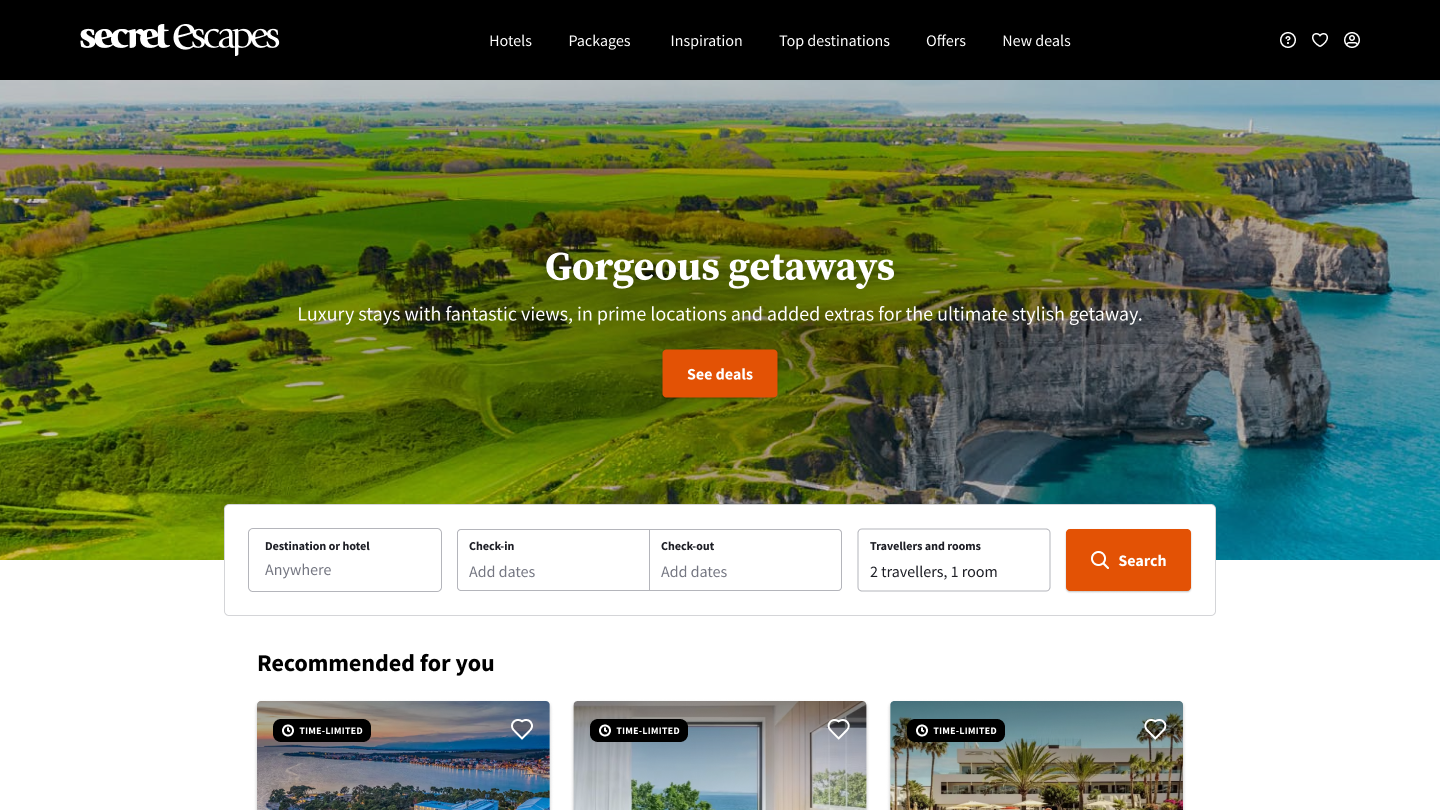
Secret Escapes is an online travel agent offering curated hotel and package holiday deals. It’s business model is built around a high-frequency email channel, surfacing deals to a large, opted-in member base.
Inventory comes through three primary channels, with deals manually loaded onto the platform. It's a model that has driven strong results historically, but is also limited by it’s scalability.
😭
Opportunity
Members who book, do so on average only 1.23 times per year. The remainder of their travel wallet is spent elsewhere, not because they’ve churned, but because limited inventory and availability means Secret Escapes can't serve their travel needs on those occasions.
- 15% of searches returned 0 results
- 49% of searches returned less than 10 results
- 84% of bookings were made by two traveller parties
“None of it is geared to children or families (despite the hotels offering family rooms on their own site). Such a shame as you are missing a big market here.” - Member, July 2025
Objectives

Activate more frequent bookings from our existing member base
Attract new customer types through broader trip type availability
Hypothesis
Third-party bed banks acts as a supplementary product, filling inventory gaps in destinations where direct supply falls short, allowing Secret Escapes to serve more frequent and diverse travel needs. To test this, we launched an MVP, adding bed banks into search results and directing the user to an off-site white-label booking flow. I supported this project across all three phases
Timeline
October 2025 – June 2026
Role
Product Design
Team
Supply Expansion Squad
Challenges
Stakeholder conversations had surfaced two core concerns: Bed banks needed to be credible enough to convert, whilst the performance of higher-margin direct supply is protected. The goal was to supplement, not compete with existing supply.
1
Unlike direct supply that has lead pricing – bed banks require dates to be added before pricing can be shown
How might we ensure pricing is available for bed bank deals during search?
Improving price visibility at search
Baymard Guidelines indicated that pricing is a critical requirement for user’s evaluating a purchase decision. This aligned with internal knowledge and personal intuition. Together with Product and Engineering we experimented with different solutions to attempt to overcome this problem.
- We ran an A/B test forcing users to add dates before searching – It showed a negative impact on conversion.
- We considered preselecting dates across all deals. This was ruled out due to high effort and API limitations.
- Competitor analysis uncovered a different solution: An on-card prompt encouraging users to add dates – communicating the reason pricing isn’t visible and an immediate action to help the user retrieve it.
Protecting the brand proposition
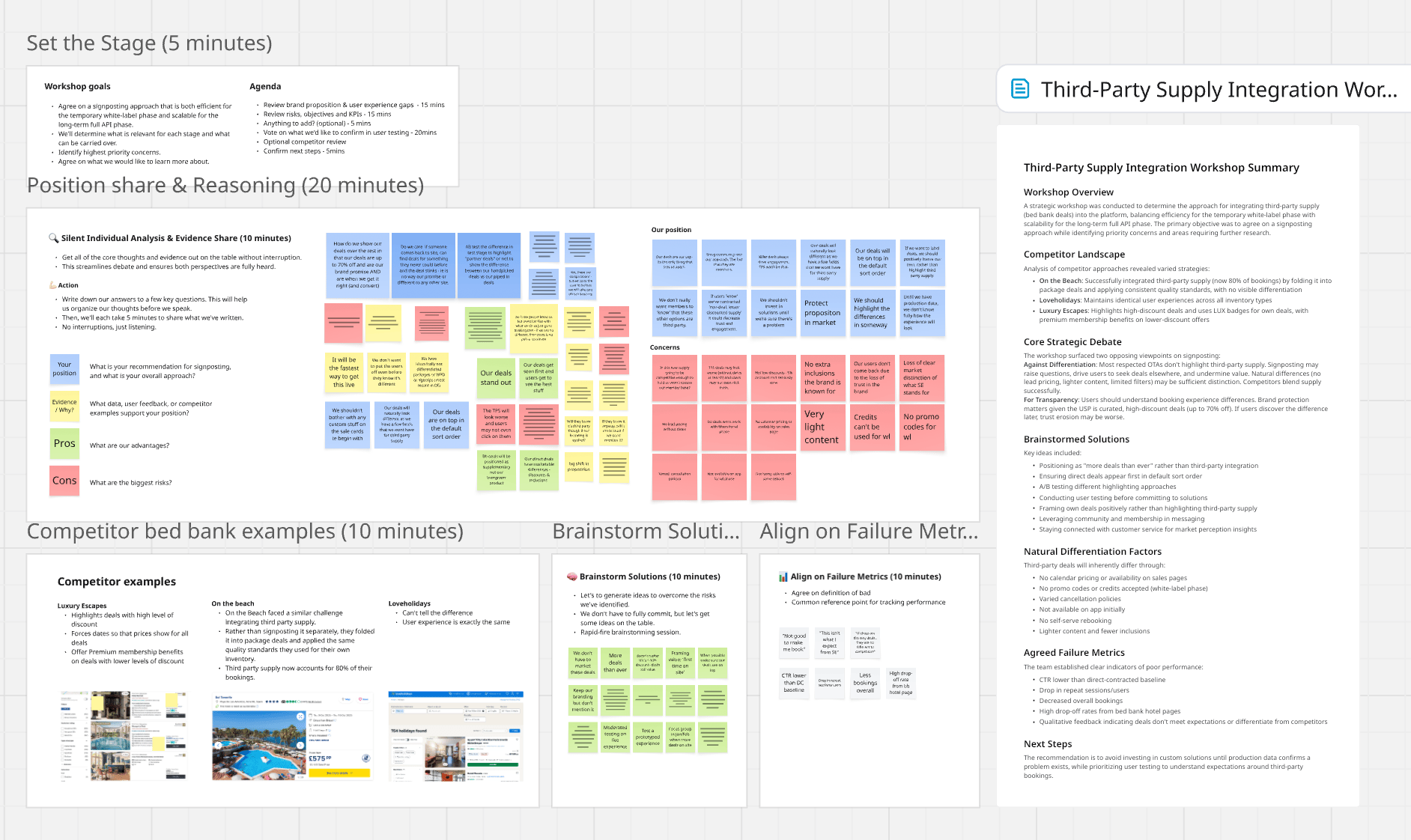
Bed bank deals don’t align with what Secret Escapes is known for – discounts and added extras. At scale, they could dominate search results and erode the reason members book. With this difference extending across the booking flow, search was the best point in the funnel to meaningfully influence customer perception.
I facilitated a workshop with Product and Brand, surfacing two decisions:
- Don't signpost bed bank deals at launch. Competitors blend third party supply successfully, and flagging differences risks signalling lower value before we have evidence of a problem.
- Frame directly contracted deals positively rather than drawing attention to what bed bank deals lack.
2
Stakeholders were concerned that bed bank deals could cannibalise directly contracted supply with higher profit margins
How might we elevate the value of directly contracted supply without diminishing bed banks?
Elevating directly contracted deals
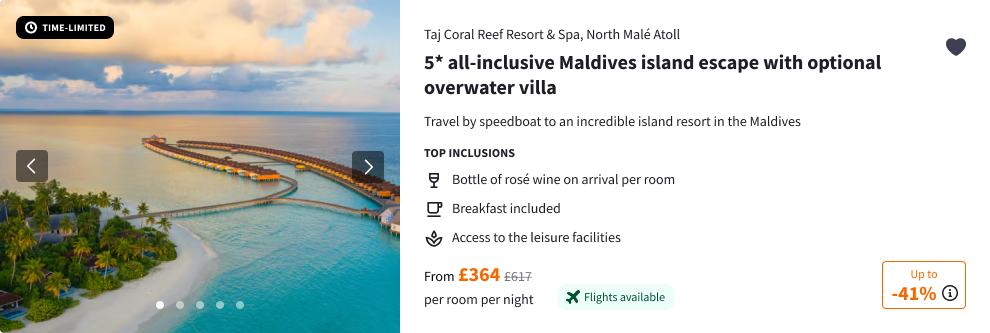
Surfacing inclusions on directly contracted deals was the clearest way to elevate their value and communicate their unique proposition. Another designer had explored this concept in an initial ideation workshop. I was asked to revise it and facilitated the session that agreed the final direction, including the decision not to signpost bed bank deals.
"Top inclusions" required legal sign-off – the label needed to signal the best inclusions across the deal, not a guaranteed list for every offer. Stakeholders had wanted to surface inclusions for some time, and chose to wait for the right technical foundation rather than ship a compromise. This was too central to the proposition to get wrong.
3
Bed bank deals lack the rich content that supports credibility and decision making
How might we bridge the trust gap between bed bank and direct supply deals?
Closing the content gap
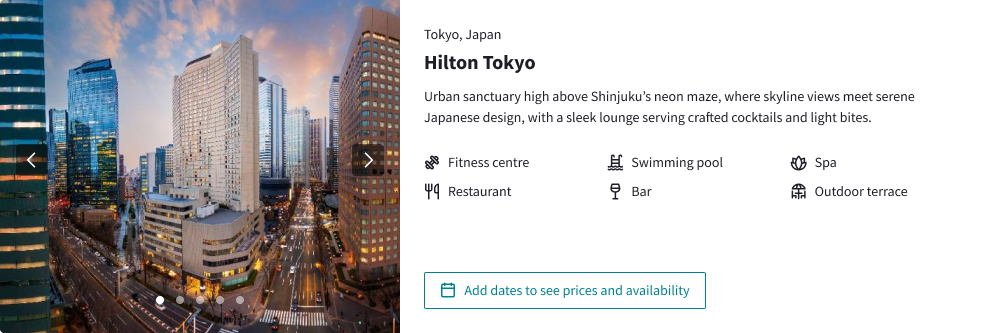
To elevate direct supply at search, we had decided to surface deal inclusions on direct supply hotel cards. By comparison, this left bed bank cards feeling bare. To identify the right content to close the gap, I referenced a closed card sorting study I had run for a previous project. Participants ranked hotel attributes in order of importance:
4
Package bookings typically generate the highest margins, whilst third-party supply risks cannibalising profitability.
How might we surface package deals without user's feeling their browsing intent has been hijacked?
Flexible booking intent
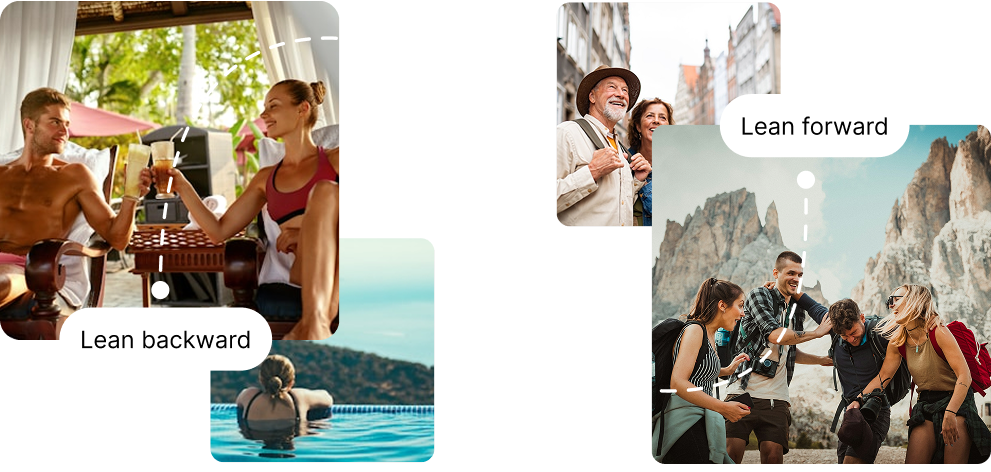
44% of bookings go beyond a hotel room, suggesting members aren't as hotel-committed as the default search experience assumes. This is reinforced by search behaviour: in sessions where members found no hotel results, 1 in 5 deliberately switched to view a package deal. Since hotels is the default product type, that switch was intentional, pointing to destination-first motivation. The insight here might suggest a larger opportunity, but within scope of this project, there was a clear commercial signal: increasing package visibility became an obvious opportunity.
Package booker motivations
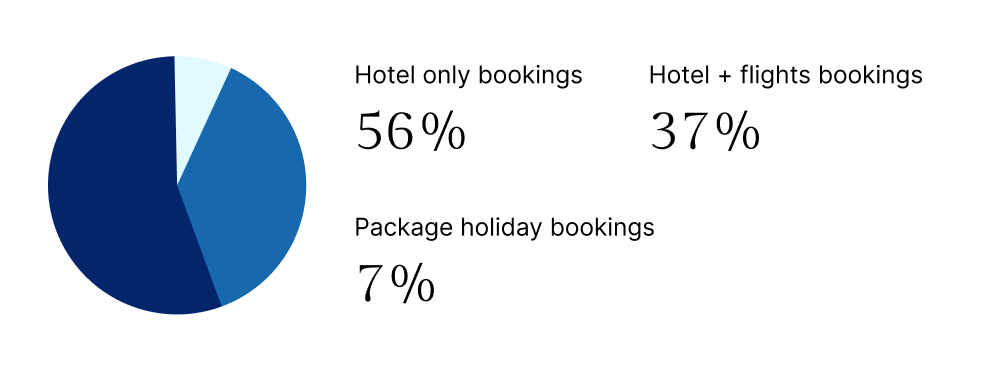
Comparing and planning travel options can feel stressful. An internal study from 2023 showed that members want a trusted partner to handle the complexity so they can focus on the inspiring parts. One participant expressed this clearly "I didn't have the time to plan and experts do it better". Some members described booking everything together as a deliberate trust strategy: "I book it all together so they have to take responsibility."
This makes packages a natural fit for members who want to feel like travellers, not logistics managers. The study also showed that trips often combine lean-back relaxation with lean-forward exploration, in an ideal balance that shifts by destination, companion, and mood.
The mobile context shaped the solution
With 73% of search sessions happening on mobile, any solution had to work within a constrained viewport. That constraint turned out to reveal something more fundamental – The product line navigational tabs weren’t immediately visible, hidden behind an interaction with the search field. Available package options weren’t visible within the hotel results list for 73% of search sessions. Not only did that indicate an important usability issue with mobile navigation, but also a clear opportunity to improve package visibility.
Search scenarios
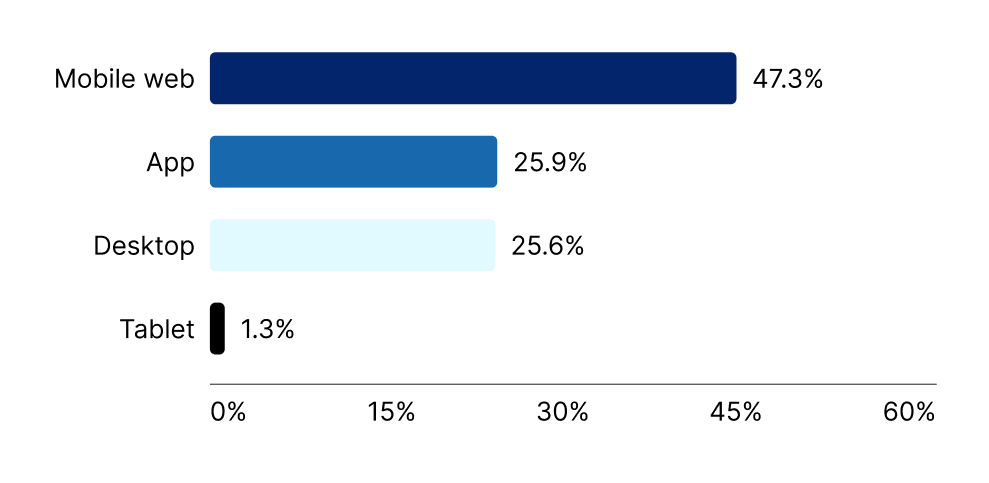
1/ Third-party hotels & packages available
2/ Both hotel types & packages available
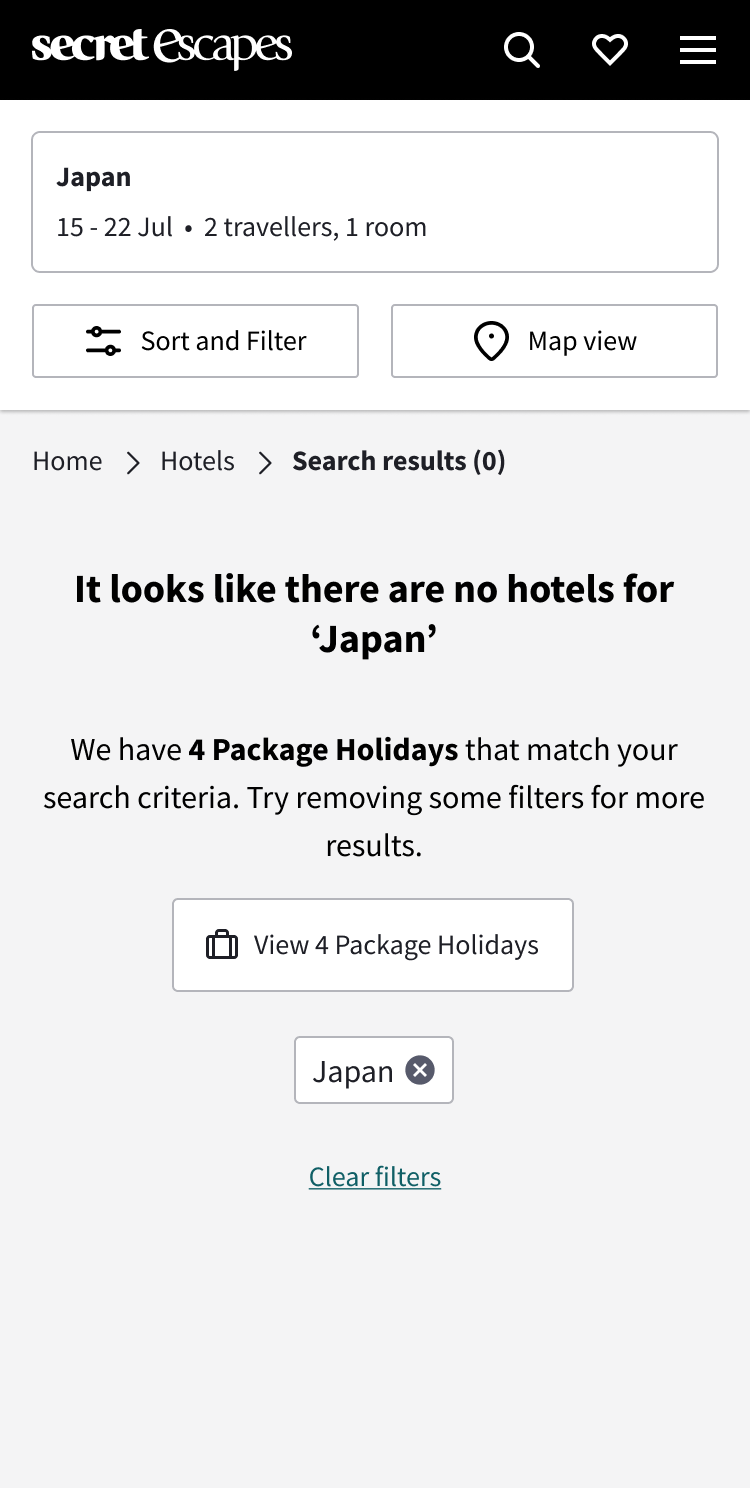
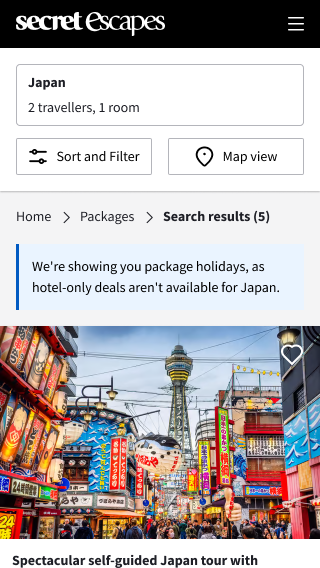
3/ No hotels, only packages available
4/ Only third-party hotels available
Design exploration
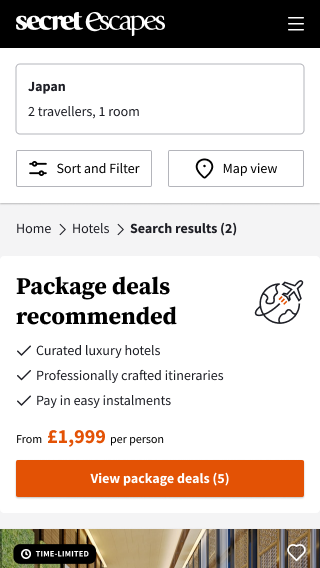
The existing packages cross-sell had a visibility problem: it only appeared in no-results states or at the bottom of hotel listings, and the design lacked the richness to feel compelling. Working with the team, we explored how to surface packages without disrupting the search experience. Two solutions emerged:
- Short-term: redirect to package results when no hotel-only deals are available. Packages fill the gap where bed bank supply is absent, keeping users in a relevant results state rather than hitting a dead end.
- Long-term: an inline banner within hotel results. Ranking logic controls its position, making it more or less prominent depending on destination relevance. Content was designed to clarify the offer and speak to the key user drivers identified in research: convenience, trust, and value.
Evaluating our solutions
We agreed to ship and measure the redirect. (impact metrics pending). I proposed user testing to understand the impact of adding the cross sell, in a low results, long haul destination scenario - a prime candidate for the packages recommendation.
What we learnt:
- Users agreed that a package recommendation made sense in this scenario and appreciated the suggestion.
- They liked that the benefits of booking a package were highlighted but wanted to know more about the specific inclusions for the destination.
- The majority of users didn’t know how to navigate back to the hotel results list after clicking through to package results - validating that not showing the product line tabs was a usability issue that not only impacted package visibility, but also created friction for members at search.
Refinement
Internal review surfaced a consistent concern: the product tabs, enriched card content, and packages banner collectively pushed search results lower, reducing their visibility and discoverability. To address this, we worked with engineering to get more out of the available screen space:
- Scrolling down hides the search bar – the user's intent has shifted to browsing
- Scrolling up restores it – signalling intent to search or filter again
- 16px side margins on mobile web give results more breathing room
Working with the commercial team, we identified destinations with low or no directly contracted hotel supply – where a packages cross-sell would be most impactful. But a recent uplift in package bookings signalled broader demand. We pivoted from the supply gap opportunity, and widened the banner's scope accordingly:
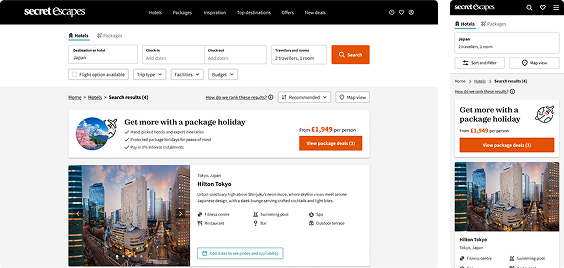
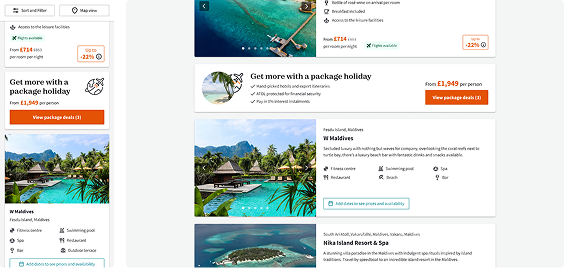
- Headline reframed as a promotion rather than destination-specific.
- Desktop graphic updated to accommodate varied destination imagery.
- Banner appears after the third directly contracted hotel, across all destinations with at least 2 package options.
- It always appears above bed bank supply.
Collaborating with the app team
Once the mobile web experience had taken shape, I reached out to the app team to understand what was technically possible within platform constraints. Getting their input early was valuable – they responded quickly with clear feedback on the key challenge: moving between hotel and package results in the app isn't straightforward, as packages aren't loaded during a hotel search.
With that context, we discussed a few different UX approaches and agreed that the best balance of effort and experience would be to trigger a fresh package search when the user taps the banner. This introduced some edge cases – such as what happens when packages aren't available, or when certain search filters can't be carried across – but these were accepted as workable constraints to design around rather than blockers.
With the direction agreed, I prototyped the experience and shared it with the app team and colleagues across Product and Design for feedback. The concept landed well, with only minor suggestions to consider. I also used AI to run a heuristic analysis of the prototype, which produced some useful prompts around best practices and interaction quality. From there, the focus shifted to working through edge cases and progressing the designs towards implementation alongside the app team.
Outcomes & Reflections
100+
Bookings within the first 2 weeks (no marketing)
+14%
In German domestic bookings (correlating with supply gaps)
-3%
Zero result searches (attributed to bed banks)
Click through date of bed bank vs. SE deals
The gap is expected, with SE deals having stronger trust signals, richer editorial content and member familiarity.
Bed bank deals
42%
SE deals
62%
Back
Integrating third-party hotel supply into search results to increase booking frequency
Background
Secret Escapes is an online travel agent offering curated hotel and package holiday deals. It’s business model is built around a high-frequency email channel, surfacing deals to a large, opted-in member base.
Inventory comes through three primary channels, with deals manually loaded onto the platform. It's a model that has driven strong results historically, but is also limited by it’s scalability.
😭
Opportunity
Members who book, do so on average only 1.23 times per year. The remainder of their travel wallet is spent elsewhere, not because they’ve churned, but because limited inventory and availability means Secret Escapes can't serve their travel needs on those occasions.
- 15% of searches returned 0 results
- 49% of searches returned less than 10 results
- 84% of bookings were made by two traveller parties
“None of it is geared to children or families (despite the hotels offering family rooms on their own site). Such a shame as you are missing a big market here.” - Member, July 2025
Objectives
Activate more frequent bookings from our existing member base
Attract new customer types through broader trip type availability
Hypothesis
Third-party bed banks acts as a supplementary product, filling inventory gaps in destinations where direct supply falls short, allowing Secret Escapes to serve more frequent and diverse travel needs. To test this, we launched an MVP, adding bed banks into search results and directing the user to an off-site white-label booking flow. I supported this project across all three phases
Timeline
October 2025 – June 2026
Role
Product Design
Team
Supply Expansion Squad
Challenges
Stakeholder conversations had surfaced two core concerns: Bed banks needed to be credible enough to convert, whilst the performance of higher-margin direct supply is protected. The goal was to supplement, not compete with existing supply.
1
Unlike direct supply that has lead pricing – bed banks require dates to be added before pricing can be shown
How might we ensure pricing is available for bed bank deals during search?
Improving price visibility at search
Baymard Guidelines indicated that pricing is a critical requirement for user’s evaluating a purchase decision. This aligned with internal knowledge and personal intuition. Together with Product and Engineering we experimented with different solutions to attempt to overcome this problem.
- We ran an A/B test forcing users to add dates before searching – It showed a negative impact on conversion.
- We considered preselecting dates across all deals. This was ruled out due to high effort and API limitations.
- Competitor analysis uncovered a different solution: An on-card prompt encouraging users to add dates – communicating the reason pricing isn’t visible and an immediate action to help the user retrieve it.
Protecting the brand proposition
Bed bank deals don’t align with what Secret Escapes is known for – discounts and added extras. At scale, they could dominate search results and erode the reason members book. With this difference extending across the booking flow, search was the best point in the funnel to meaningfully influence customer perception.
I facilitated a workshop with Product and Brand, surfacing two decisions:
- Don't signpost bed bank deals at launch. Competitors blend third party supply successfully, and flagging differences risks signalling lower value before we have evidence of a problem.
- Frame directly contracted deals positively rather than drawing attention to what bed bank deals lack.
2
Stakeholders were concerned that bed bank deals could cannibalise directly contracted supply with higher profit margins
How might we elevate the value of directly contracted supply without diminishing bed banks?
Elevating directly contracted deals
Surfacing inclusions on directly contracted deals was the clearest way to elevate their value and communicate their unique proposition. Another designer had explored this concept in an initial ideation workshop. I was asked to revise it and facilitated the session that agreed the final direction, including the decision not to signpost bed bank deals.
"Top inclusions" required legal sign-off – the label needed to signal the best inclusions across the deal, not a guaranteed list for every offer. Stakeholders had wanted to surface inclusions for some time, and chose to wait for the right technical foundation rather than ship a compromise. This was too central to the proposition to get wrong.
3
Bed bank deals lack the rich content that supports credibility and decision making
How might we bridge the trust gap between bed bank and direct supply deals?
Closing the content gap
To elevate direct supply at search, we had decided to surface deal inclusions on direct supply hotel cards. By comparison, this left bed bank cards feeling bare. To identify the right content to close the gap, I referenced a closed card sorting study I had run for a previous project. Participants ranked hotel attributes in order of importance:
4
Package bookings typically generate the highest margins, whilst third-party supply risks cannibalising profitability.
How might we surface package deals without user's feeling their browsing intent has been hijacked?
Package booker motivations
Comparing and planning travel options can feel stressful. An internal study from 2023 showed that members want a trusted partner to handle the complexity so they can focus on the inspiring parts. One participant expressed this clearly "I didn't have the time to plan and experts do it better". Some members described booking everything together as a deliberate trust strategy: "I book it all together so they have to take responsibility."
This makes packages a natural fit for members who want to feel like travellers, not logistics managers. The study also showed that trips often combine lean-back relaxation with lean-forward exploration, in an ideal balance that shifts by destination, companion, and mood.
Flexible booking intent
44% of bookings go beyond a hotel room, suggesting members aren't as hotel-committed as the default search experience assumes. This is reinforced by search behaviour: in sessions where members found no hotel results, 1 in 5 deliberately switched to view a package deal. Since hotels is the default product type, that switch was intentional, pointing to destination-first motivation. The insight here might suggest a larger opportunity, but within scope of this project, there was a clear commercial signal: increasing package visibility became an obvious opportunity.
The mobile context shaped the solution
With 73% of search sessions happening on mobile, any solution had to work within a constrained viewport. That constraint turned out to reveal something more fundamental – The product line navigational tabs weren’t immediately visible, hidden behind an interaction with the search field. Available package options weren’t visible within the hotel results list for 73% of search sessions. Not only did that indicate an important usability issue with mobile navigation, but also a clear opportunity to improve package visibility.
Search scenarios
1/ Third-party hotels & packages available
2/ Both hotel types & packages available
3/ No hotels, only packages available
4/ Only third-party hotels available
Design exploration
The existing packages cross-sell had a visibility problem: it only appeared in no-results states or at the bottom of hotel listings, and the design lacked the richness to feel compelling. Working with the team, we explored how to surface packages without disrupting the search experience. Two solutions emerged:
- Short-term: redirect to package results when no hotel-only deals are available. Packages fill the gap where bed bank supply is absent, keeping users in a relevant results state rather than hitting a dead end.
- Long-term: an inline banner within hotel results. Ranking logic controls its position, making it more or less prominent depending on destination relevance. Content was designed to clarify the offer and speak to the key user drivers identified in research: convenience, trust, and value.
Evaluating our solutions
We agreed to ship and measure the redirect. (impact metrics pending). I proposed user testing to understand the impact of adding the cross sell, in a low results, long haul destination scenario - a prime candidate for the packages recommendation.
What we learnt:
- Users agreed that a package recommendation made sense in this scenario and appreciated the suggestion.
- They liked that the benefits of booking a package were highlighted but wanted to know more about the specific inclusions for the destination.
- The majority of users didn’t know how to navigate back to the hotel results list after clicking through to package results - validating that not showing the product line tabs was a usability issue that not only impacted package visibility, but also created friction for members at search.
Refinement
Internal review surfaced a consistent concern: the product tabs, enriched card content, and packages banner collectively pushed search results lower, reducing their visibility and discoverability. To address this, we worked with engineering to get more out of the available screen space:
- Scrolling down hides the search bar – the user's intent has shifted to browsing
- Scrolling up restores it – signalling intent to search or filter again
- 16px side margins on mobile web give results more breathing room
Working with the commercial team, we identified destinations with low or no directly contracted hotel supply – where a packages cross-sell would be most impactful. But a recent uplift in package bookings signalled broader demand. We pivoted from the supply gap opportunity, and widened the banner's scope accordingly:
- Headline reframed as a promotion rather than destination-specific.
- Desktop graphic updated to accommodate varied destination imagery.
- Banner appears after the third directly contracted hotel, across all destinations with at least 2 package options.
- It always appears above bed bank supply.
Collaborating with the app team
Once the mobile web experience had taken shape, I reached out to the app team to understand what was technically possible within platform constraints. Getting their input early was valuable – they responded quickly with clear feedback on the key challenge: moving between hotel and package results in the app isn't straightforward, as packages aren't loaded during a hotel search.
With that context, we discussed a few different UX approaches and agreed that the best balance of effort and experience would be to trigger a fresh package search when the user taps the banner. This introduced some edge cases – such as what happens when packages aren't available, or when certain search filters can't be carried across – but these were accepted as workable constraints to design around rather than blockers.
With the direction agreed, I prototyped the experience and shared it with the app team and colleagues across Product and Design for feedback. The concept landed well, with only minor suggestions to consider. I also used AI to run a heuristic analysis of the prototype, which produced some useful prompts around best practices and interaction quality. From there, the focus shifted to working through edge cases and progressing the designs towards implementation alongside the app team.
Outcomes & Reflections
100+
Bookings within the first 2 weeks (no marketing)
+14%
In German domestic bookings (correlating with supply gaps)
-3%
Zero result searches (attributed to bed banks)
Click through date of bed bank vs. SE deals
The gap is expected, with SE deals having stronger trust signals, richer editorial content and member familiarity.
Bed bank deals
42%
SE deals
62%


Back
Integrating third-party hotel supply into search results to increase booking frequency
Background
Secret Escapes is an online travel agent selling curated hotel and package deals. Its model centres on a high-frequency email channel reaching a large opted-in membership with inventory manually loaded across three primary supply channels.
Opportunity
Members book just 1.23 times a year on average – not because they've churned, but because limited inventory means Secret Escapes can't serve every travel Occassion.
- 15% of searches returned 0 results
- 49% of searches returned less than 10 results
- 84% of bookings were made by two traveller parties
“None of it is geared to children or families (despite the hotels offering family rooms on their own site). Such a shame as you are missing a big market here.” - Member, July 2025
😭
Objectives
Activate more frequent bookings from our existing member base
Attract new customer types through broader trip type availability
Hypothesis
Third-party bed banks acts as a supplementary product, filling inventory gaps in destinations where direct supply falls short, allowing Secret Escapes to serve more frequent and diverse travel needs. To test this, we launched an MVP, adding bed banks into search results and directing the user to an off-site white-label booking flow. I supported this project across all three phases: White-label, Bridging, and Full API.
Timeline
October 2025 – June 2026
Role
Product Design
Team
Supply Expansion Squad
Challenges
Stakeholder conversations had surfaced two core concerns: Bed banks needed to be credible enough to convert, whilst the performance of higher-margin direct supply is protected. The goal was to supplement, not compete with existing supply.
1
Unlike direct supply that has lead pricing – bed banks require dates to be added before pricing can be shown
How might we ensure pricing is available for bed bank deals during search?
Improving price visibility at search
Baymard Guidelines indicated that pricing is a critical requirement for user’s evaluating a purchase decision. This aligned with internal knowledge and personal intuition. Together with Product and Engineering we experimented with different solutions to attempt to overcome this problem.
- We ran an A/B test forcing users to add dates before searching – It showed a negative impact on conversion.
- We considered preselecting dates across all deals. This was ruled out due to high effort and API limitations.
- Competitor analysis uncovered a different solution: An on-card prompt encouraging users to add dates – communicating the reason pricing isn’t visible and an immediate action to help the user retrieve it.
Protecting the brand proposition
Bed bank deals don’t align with what Secret Escapes is known for – discounts and added extras. At scale, they could dominate search results and erode the reason members signed up. With this difference extending throughout the booking flow, search was the best point in the funnel to meaningfully influence perception.
I facilitated a workshop with Product and Brand, surfacing two decisions:
- Don't signpost bed bank deals at launch. Flagging differences risks signalling lower value before we have evidence of a problem.
- Frame directly contracted deals positively rather than drawing attention to what bed bank deals lack.
2
Stakeholders were concerned that bed bank deals could cannibalise directly contracted supply with higher profit margins.
How might we elevate the value of directly contracted supply without diminishing bed banks?
Elevating directly contracted deals
Surfacing inclusions on directly contracted deals was the clearest way to elevate their value and communicate their unique proposition. Another designer had explored this concept in an initial ideation workshop. I was asked to revise it and facilitated the session that agreed the final direction, including the decision not to signpost bed bank deals.
"Top inclusions" required legal sign-off – the label needed to signal the best inclusions across the deal, not a guaranteed list for every offer. Stakeholders had wanted to surface inclusions for some time, and chose to wait for the right technical foundation rather than ship a compromise. This was too central to the proposition to get wrong.
3
Bed bank deals lack the rich content that supports credibility and decision making
How might we bridge the trust gap between bed bank and direct supply deals and support decision making?
Closing the content gap
Without richer content, bed banks felt untrustworthy and harder to evaluate, increasing the likelihood of members abandoning or clicking through without confidence.
To identify the right content to close the gap, I drew on a card sorting study I had run during a previous hotel pooling project. Participants ranked hotel attributes in order of importance: location, visual appeal, star rating, price, room types, and facilities.
Star rating ranked highly, but applying it only to bed bank cards would have made them feel more premium than directly contracted deals, undermining higher margin inventory. Facilities was the right call – it closed the content gap and gave members something tangible to evaluate, without distorting the perceived hierarchy between supply types.
4
Package bookings typically generate the highest margins, whilst third-party supply risks cannibalising profitability.
How might we surface package deals without user's feeling their browsing intent has been hijacked?
Package booker motivations
Comparing and planning travel options can feel stressful. An internal study from 2023 showed that members want a trusted partner to handle the complexity so they can focus on the inspiring parts. One participant expressed this clearly "I didn't have the time to plan and experts do it better". Some members described booking everything together as a deliberate trust strategy: "I book it all together so they have to take responsibility."
This makes packages a natural fit for members who want to feel like travellers, not logistics managers. The study also showed that trips often combine lean-back relaxation with lean-forward exploration, in an ideal balance that shifts by destination, companion, and mood.
Flexible booking intent
44% of bookings go beyond a hotel room, suggesting members aren't as hotel-committed as the default search experience assumes. This is reinforced by search behaviour: in sessions where members found no hotel results, 1 in 5 deliberately switched to view a package deal. Since hotels is the default product type, that switch was intentional, pointing to destination-first motivation. The insight here might suggest a larger opportunity, but within scope of this project, there was a clear commercial signal: increasing package visibility became an obvious opportunity.
The mobile context shaped the solution
With 73% of search sessions happening on mobile, any solution had to work within a constrained viewport. That constraint turned out to reveal something more fundamental – The product line navigational tabs weren’t immediately visible, hidden behind an interaction with the search field. Available package options weren’t visible within the hotel results list for 73% of search sessions. Not only did that indicate an important usability issue with mobile navigation, but also a clear opportunity to improve package visibility.
Search scenarios
1/ Third-party hotels & packages available
2/ Both hotel types & packages available
3/ No hotels, only packages available
4/ Only third-party hotels available
Design exploration
The existing packages cross-sell had a visibility problem: it only appeared in no-results states or at the bottom of hotel listings, and the design lacked the richness to feel compelling. Working with the team, we explored how to surface packages without disrupting the search experience. Two solutions emerged:
- Short-term: redirect to package results when no hotel-only deals are available. Packages fill the gap where bed bank supply is absent, keeping users in a relevant results state rather than hitting a dead end.
- Long-term: an inline banner within hotel results. Ranking logic controls its position, making it more or less prominent depending on destination relevance. Content was designed to clarify the offer and speak to the key user drivers identified in research: convenience, trust, and value.
Evaluating our solutions
We agreed to ship and measure the redirect. (impact metrics pending). I proposed user testing to understand the impact of adding the cross sell, in a low results, long haul destination scenario - a prime candidate for the packages recommendation.
What we learnt:
- Users agreed that a package recommendation made sense in this scenario and appreciated the suggestion.
- They liked that the benefits of booking a package were highlighted but wanted to know more about the specific inclusions for the destination.
- The majority of users didn’t know how to navigate back to the hotel results list after clicking through to package results - validating that not showing the product line tabs was a usability issue that not only impacted package visibility, but also created friction for members at search.
Refinement
Internal review surfaced a consistent concern: the product tabs, enriched card content, and packages banner collectively pushed search results lower, reducing their visibility and discoverability. To address this, we worked with engineering to get more out of the available screen space:
- Scrolling down hides the search bar – the user's intent has shifted to browsing
- Scrolling up restores it – signalling intent to search or filter again
- 16px side margins on mobile web give results more breathing room
Working with the commercial team, we identified destinations with low or no directly contracted hotel supply – where a packages cross-sell would be most impactful. But a recent uplift in package bookings signalled broader demand. We pivoted from the supply gap opportunity, and widened the banner's scope accordingly:
- Headline reframed as a promotion rather than destination-specific.
- Desktop graphic updated to accommodate varied destination imagery.
- Banner appears after the third directly contracted hotel, across all destinations with at least 2 package options.
- It always appears above bed bank supply.
Collaborating with the app team
Once the mobile web experience had taken shape, I reached out to the app team to understand what was technically possible within platform constraints. Getting their input early was valuable – they responded quickly with clear feedback on the key challenge: moving between hotel and package results in the app isn't straightforward, as packages aren't loaded during a hotel search.
With that context, we discussed a few different UX approaches and agreed that the best balance of effort and experience would be to trigger a fresh package search when the user taps the banner. This introduced some edge cases – such as what happens when packages aren't available, or when certain search filters can't be carried across – but these were accepted as workable constraints to design around rather than blockers.
With the direction agreed, I prototyped the experience and shared it with the app team and colleagues across Product and Design for feedback. The concept landed well, with only minor suggestions to consider. I also used AI to run a heuristic analysis of the prototype, which produced some useful prompts around best practices and interaction quality. From there, the focus shifted to working through edge cases and progressing the designs towards implementation alongside the app team.
Outcomes & Reflections
The designs were presented to Alex Saint (CEO) and senior executives, and received positively. Alex noted that the packages cross-sell should remain visible even as bed bank supply scales – a signal that the feature has strategic value beyond its original scope.
100+
Bookings within the first 2 weeks (no marketing)
+14%
In German domestic bookings (correlating with supply gaps)
-3%
Zero result searches (attributed to bed banks)
Click through date of bed bank vs. SE deals
The gap is expected, with SE deals having stronger trust signals, richer editorial content and member familiarity.
Bed bank deals
42%
SE deals
62%